Dental Bridge vs Implant: Which Is Right for One Missing Tooth?
A bridge is faster and cheaper but permanently alters two healthy teeth. Here is the real trade on lifespan, cost over twenty years, and when a bridge is the better choice.
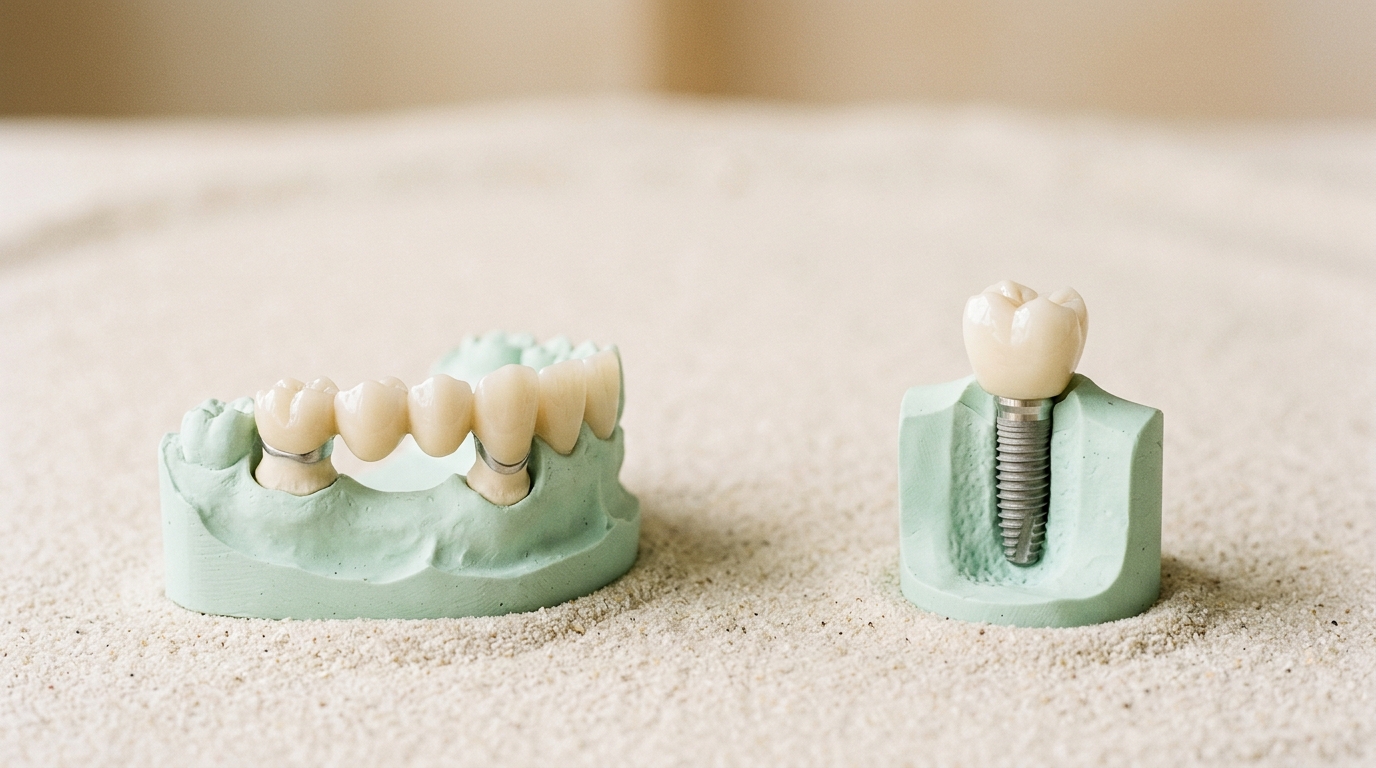
You have one gap, and you've been offered two ways to fill it. The bridge costs roughly half as much and can be finished in two or three weeks. The implant costs more and takes months.
Put like that, it barely looks like a decision. The thing that makes it one is a detail that often gets a single sentence in the consultation: to fit a traditional bridge, the two healthy teeth on either side of your gap have to be cut down. Not cleaned, not adjusted. Reduced with a drill, permanently, so crowns can be seated over them.
That's the actual trade. Surgery in the bone versus irreversible work on two teeth that currently have nothing wrong with them. Everything else, lifespan, cost, cleaning, follows from it.
What a Bridge Actually Involves
A bridge replaces a missing tooth by hanging a false one between its neighbors. The false tooth is called a pontic, and it doesn't touch bone at all. It rests on the gum surface. The teeth carrying it are the abutment teeth, and they hold the whole thing up.
To do that, each abutment tooth is prepared: a layer of enamel is removed all the way around so a crown can fit over it without making the tooth bulky. The three units, crown, pontic, crown, are then made as one piece and cemented in place.
Two consequences you should be clear about before you agree:
- It cannot be undone. Enamel does not grow back. A tooth prepared for a bridge will need a crown on it for the rest of its life, whatever happens to the bridge.
- Preparing a healthy tooth carries a real risk of nerve trouble. Removing enamel and dentine gets closer to the pulp inside, and a proportion of prepared teeth eventually need a root canal. It doesn't happen often, but it happens, and when it does you've acquired a problem on a tooth that was fine before.
If the neighboring teeth already have large fillings or existing crowns, this argument mostly evaporates. You're not sacrificing anything: those teeth were going to need covering eventually. That single fact is the strongest predictor of which option makes sense.
The Three Kinds of Bridge
Not all bridges take the same bite out of your teeth.
- Traditional bridge. Full crowns on both neighbors, pontic between. The strongest and the most destructive. This is what most people mean by a bridge.
- Cantilever bridge. Supported on one side only. Uses fewer teeth but puts leverage on the single abutment, so it's used selectively and usually not on back teeth taking heavy chewing force.
- Maryland bridge, also called a resin-bonded bridge. The pontic is attached to metal or ceramic wings that are bonded to the back surfaces of the neighboring teeth, with minimal or no drilling. Far more conservative, and genuinely useful for front teeth. The trade is that bonded wings come unstuck more often than cemented crowns, and it isn't strong enough for molars.
If your gap is a front tooth and the neighbors are untouched, ask specifically about a Maryland bridge. It's frequently the right answer for a teenager waiting for growth to finish, and it's often not offered unless you raise it.
Head to Head
| Traditional bridge | Single implant | |
|---|---|---|
| Neighboring teeth | Both cut down permanently | Untouched |
| Surgery | None | Yes, sometimes with grafting first |
| Time to finish | Two to four weeks | Four months to over a year |
| Bone under the gap | Continues to shrink | Preserved around the implant |
| Typical lifespan | Ten to fifteen years, sometimes longer | Fixture often decades, crown ten to twenty years |
| How it usually fails | Decay at the crown margins, or an abutment tooth failing | Bone loss around the fixture from peri-implantitis |
| What failure costs you | Often the supporting teeth too | Usually just the site, which can often be redone |
| Cleaning | Thread floss under the pontic daily, or a floss threader | Brush and clean around it like a normal tooth |
| Typical upfront cost | $2,000 to $5,000 for a three unit bridge | $3,000 to $6,000 for the finished tooth |
| Over twenty years | Often one or two replacements | Usually one crown replacement |
These are ranges, not quotes. Material choice, your location, whether grafting is needed, and how many units the bridge spans all move the figures, and only an itemized written plan from your own dentist reflects what you'd actually pay.
Lifespan, and What Actually Ends Each One
Bridges have a good record. Plenty last well past a decade. What ends them is rarely the bridge itself breaking.
The usual failure is decay at the margin, the line where the crown meets the tooth underneath it. That line sits at or below the gum, it's hard to clean, and cement can wash out of it over the years. Decay gets in, spreads inside the abutment tooth where you can't see it, and by the time the bridge feels loose the tooth beneath may be badly compromised.
That's the asymmetry that matters most. When a bridge fails, it often takes an abutment tooth with it, and a three unit bridge becomes a bigger problem than the one it solved. You started with one gap and can end up with two.
Implants fail differently. The crown chips or wears and gets replaced, which is routine. The serious mode is bone loss around the fixture, driven by plaque, smoking, or grinding. When that happens the implant is usually lost, but your other teeth aren't involved, and the site can often be grafted and redone. Our article on how long implants last covers that in detail.
Both need cleaning, and each has a specific weak point. For a bridge it's underneath the pontic, where a floss threader or a threaded floss is the only thing that reaches. For an implant it's the collar of gum where the crown meets tissue.
The Bone Question
A bridge does nothing for the bone under the gap. The pontic sits on the gum and transmits no load into the ridge, so the bone underneath keeps shrinking exactly as it would if you'd left the space empty. Over years that shows: a small dark triangle appears under the pontic where the gum has receded away from it, and food starts catching there.
An implant loads the bone directly and preserves the ridge around itself. We cover why bone behaves this way in our comparison of implants and dentures, and it's the same mechanism.
This matters most for a front tooth, where a receding gumline under a pontic is visible when you smile, and it matters over the long term for anyone young enough to be living with the result for thirty years.
Cost Over Twenty Years
On the day you decide, the bridge is usually cheaper, sometimes substantially. That advantage narrows over time in a way that's worth thinking through.
A bridge replaced twice across twenty years costs more than a bridge quoted once. And a replacement is not a like for like repeat: if an abutment tooth has decayed underneath, the second bridge may need to be longer, involving another tooth, or the tooth may need a root canal and post first, or it may not be salvageable at all. The costs escalate in the wrong direction.
An implant front loads the spending. Once the fixture is integrated and healthy, the ongoing cost is hygiene visits and eventually a crown.
Insurance often tilts things the other way in the short run, because many plans cover bridges more readily than implants, and some pay only what a bridge would have cost even when you choose an implant. That's a real consideration, and it's worth getting a pre-treatment estimate for both before deciding.
When a Bridge Is Genuinely the Better Call
There are situations where a bridge is not the compromise option, it's the right one.
- The neighboring teeth already have crowns or large fillings. Nothing healthy is being destroyed, and you get two problems fixed with one piece of work.
- You're not a candidate for surgery. Certain medications, medical conditions, or a history of radiation to the jaw make implant surgery inadvisable. A bridge sidesteps the surgery entirely.
- You don't have the bone and don't want grafting. Grafting is safe and routine, but it's more surgery, more months, and more money. Declining it is a legitimate choice.
- You need it done soon. A wedding, a job change, a move abroad, or simply not wanting a gap for the better part of a year.
- You smoke and aren't going to stop. Smoking substantially raises implant failure risk. A bridge doesn't care.
- The budget is fixed and financing isn't realistic. A well made bridge that lasts twelve years is a far better outcome than an implant you can't afford to finish properly.
- You're a teenager waiting for growth to finish. Implants can't be placed until jaw growth is complete, and a Maryland bridge holds the space and the appearance in the meantime.
The one situation where a bridge is a poor idea regardless of budget: when an abutment tooth is already weak. Asking a compromised tooth to carry a bridge for a decade is how one lost tooth turns into three.
Frequently Asked Questions
Is a bridge cheaper than an implant?
Upfront, usually yes, often by a meaningful margin, and insurance frequently covers more of it. Across twenty years the gap narrows, because bridges are typically replaced at least once and a replacement can involve additional work on the supporting teeth.
Do they really have to file down my healthy teeth?
For a traditional bridge, yes. Enough enamel is removed all the way around each neighbor for a crown to fit. A Maryland bridge avoids most of this by bonding to the back surfaces instead, though it's limited to front teeth and comes loose more often.
How long does a dental bridge last?
Commonly ten to fifteen years, and often longer with good cleaning and no decay at the margins. The main threat is decay creeping in where the crown meets the tooth, which is why flossing under the pontic every day is not optional.
Can I have an implant later if I get a bridge now?
Usually yes, but the bone under the pontic keeps shrinking in the meantime, so grafting is more likely by then. The prepared teeth will also still need crowns whatever you decide later.
Which is better for a front tooth?
An implant generally wins on appearance over the long run, because it holds the bone and gum in place. If the neighbors are untouched and you want to avoid drilling them, a Maryland bridge is the conservative middle option worth asking about specifically.
What to Do Next
Ask your dentist one question before anything else: what condition are the two teeth beside the gap in right now? If they're already crowned or heavily filled, a bridge is a strong option and the main objection to it doesn't apply to you. If they're pristine, you're being asked to trade two healthy teeth for speed and cost, and that deserves more thought than it usually gets.
Then get both plans in writing with a pre-treatment estimate from your insurer for each. The coverage difference is often larger than people expect and can reasonably decide it.
This article is for general information only and is not a substitute for professional dental advice. Always consult your dentist about your individual needs.