Oral Cancer Screening: What Your Dentist Is Looking For
What happens during an oral cancer screening, the signs worth acting on, how HPV and other risk factors fit in, and a calm two-minute self-check you can do at home.
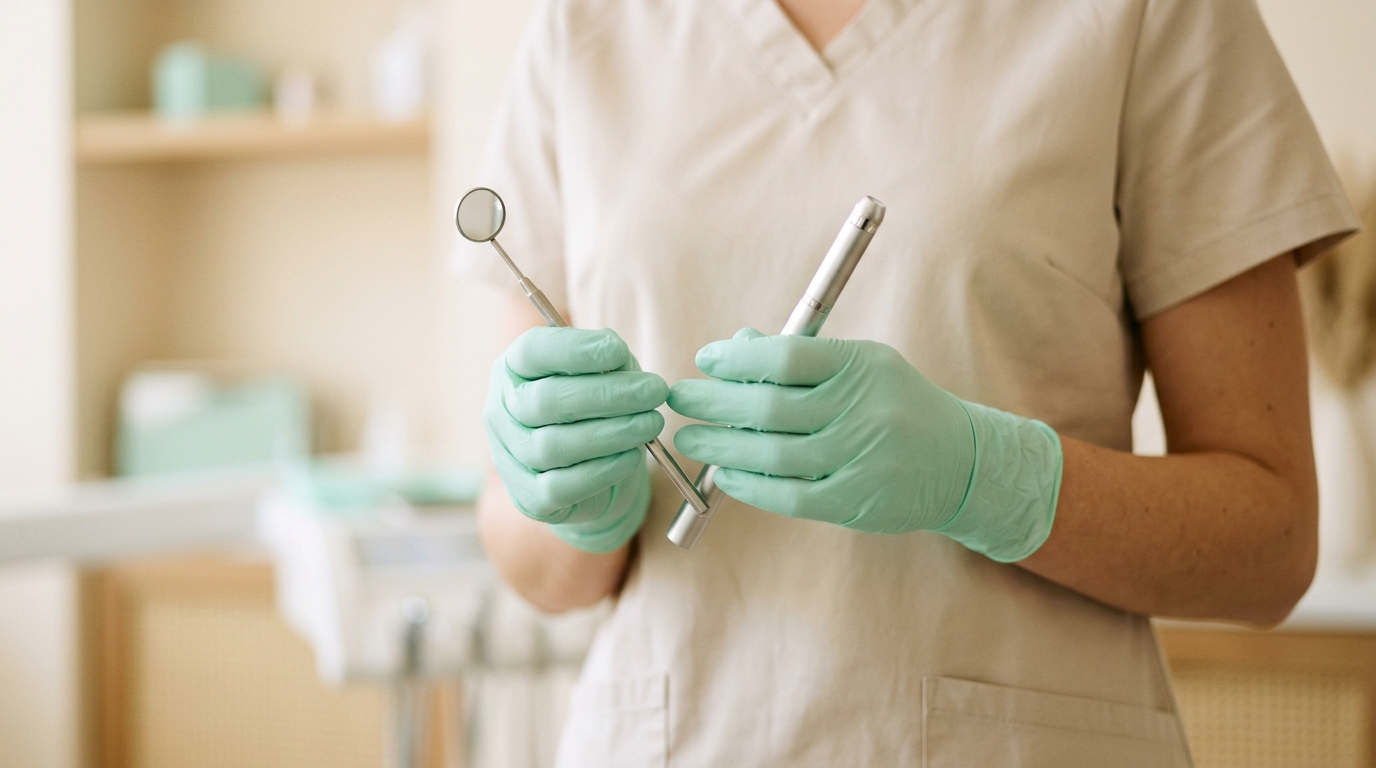
Your dentist held your tongue with a piece of gauze, felt along your jaw and neck, and moved on. That was the oral cancer screening. It takes a couple of minutes and often goes by without being named, which is why most people don't realize it happened.
Here is the one thing to take away, and it's simple enough to act on today: anything in your mouth that hasn't healed in two weeks should be looked at. A sore, an ulcer, a lump, a rough patch, a red or white area. Two weeks. Most of what gets checked turns out to be harmless, and the checking is quick.
Oral cancer is not common, and the odds are strongly in your favor. But it's a condition where finding it early changes the outcome a great deal, and the early stages are usually painless, which is exactly why they get ignored. Here's what your dentist is doing, what the real risk factors are, and how to check yourself.
What Happens During an Oral Cancer Screening
The exam is visual and tactile. No dye, no machine, nothing uncomfortable. Your dentist or hygienist is systematically looking at and feeling every surface, because parts of your mouth are hard to see and easy to skip.
They will typically:
- Look at your face, lips, and neck for asymmetry or swelling
- Feel the lymph nodes in your neck and under your jaw, the small glands that filter fluid and swell when something nearby is irritated or diseased
- Pull your lips out and check the inside surfaces and the gums behind them
- Check your cheeks, running a finger along the inside while looking at the tissue
- Hold your tongue in gauze and pull it gently to each side, because the sides and underside of the tongue are among the most common sites and cannot be seen otherwise
- Ask you to lift your tongue so they can see the floor of your mouth
- Look at the roof of your mouth and the soft tissue at the back
- Press with a finger along the floor of the mouth and the tongue, feeling for anything firm underneath
They are looking for lesions, meaning any area of abnormal tissue. Most lesions in a mouth are ordinary things: a cheek bitten while chewing, a spot rubbed by a denture, a cold sore, an ulcer from stress. What draws attention is a lesion that has no obvious cause, or one that has been there too long.
This screening is normally part of a routine checkup rather than something billed separately. If nobody has mentioned it to you, it's fair to ask at your next visit: "Do you do an oral cancer screening as part of the exam?" A good office will say yes and tell you what they check.
The Signs Worth Acting On
Read this table as a prompt to make a phone call, not a diagnosis. Almost every item here has common harmless causes. The pattern that matters is persistence.
| What you notice | Common harmless explanations | When to get it checked |
|---|---|---|
| A sore or ulcer in your mouth | Bitten cheek, canker sore, denture rubbing, sharp tooth edge | If it hasn't healed in two weeks, get it looked at |
| A white patch that won't wipe off | Friction from a tooth or cheek biting, thrush if it does wipe off | Any persistent white patch, called leukoplakia, needs assessment |
| A red patch, smooth or velvety | Irritation, denture sore, inflammation | Promptly. A persistent red patch, called erythroplakia, is taken more seriously than a white one |
| A lump or thickened area | Bony bump you've always had, salivary gland stone, swollen node from a cold | If it's new, growing, firm, or still there after two to three weeks |
| Numbness or tingling in lip, tongue, or chin | Recent dental injection, pressure on a nerve | Unexplained numbness that persists is always worth investigating |
| A neck lump | Swollen node from a recent infection | If it's painless, firm, or lasts more than a few weeks |
| Persistent sore throat or hoarseness | Cold, reflux, voice overuse, allergies | Beyond a few weeks with no clear cause, see your doctor |
| Difficulty or pain swallowing, or a feeling of something stuck | Reflux, muscle tension, anxiety | If it persists rather than passing with the cold that caused it |
| A tooth that becomes loose with no gum disease | Advanced gum disease, injury | Loose teeth without a dental explanation need investigation |
The single most useful rule is the two week one. Normal mouth tissue heals fast, faster than skin. Something that is still there after two weeks is not following the normal script, and that is worth two minutes of a professional's attention.
If a sore, patch, or lump is also growing, or is firm and fixed to the tissue underneath rather than moving freely, don't wait out the two weeks. Call now.
What Raises the Risk
Risk factors shift the odds. They don't determine anything, and a substantial share of oral cancers occur in people with none of them, which is a good reason for everyone to know the two week rule rather than only people who think they qualify.
Tobacco in any form. Cigarettes, cigars, pipes, and smokeless tobacco such as chewing tobacco and snuff. This is the most firmly established risk factor there is, and smokeless tobacco is not a safe alternative. The risk falls after quitting, though it takes years to approach that of someone who never used it.
Alcohol, particularly heavy or long term drinking. Alcohol and tobacco together raise risk considerably more than either alone, because alcohol appears to make tissues more permeable to the carcinogens in tobacco.
HPV, the human papillomavirus, a very common group of viruses spread by skin to skin and sexual contact. Certain high risk types, HPV 16 in particular, are linked to cancers at the back of the throat, the tonsils, and the base of the tongue. Most people are exposed to HPV at some point and clear it without ever knowing, and only a small fraction of infections persist and cause problems. HPV related cancers behave somewhat differently from tobacco related ones: they tend to occur in people who are younger and often have never smoked, and they often show up first as a painless neck lump rather than a mouth sore. HPV vaccination is given to prevent these cancers, and that is a conversation for your doctor.
Sun exposure for lip cancer specifically. Lips get overlooked in sunscreen routines. Use a lip balm with SPF if you spend time outdoors.
Age and sex. Risk rises with age, and rates are higher in men, though the gap has been narrowing.
A previous oral cancer, which raises the risk of a second one and means lifelong follow up.
A few things worth naming as not established: there is no good evidence linking mouthwash, dental fillings, or root canals to oral cancer. Chronic irritation from a sharp tooth or ill fitting denture is worth fixing on its own merits, but it is not a proven cause of cancer.
How to Check Yourself at Home
A self check takes two minutes and needs a mirror and good light. Once a month is plenty. The aim is not to diagnose anything, it's to notice change, which you're better placed to do than anyone because you see your mouth more often than your dentist does.
- Face and neck. Look in the mirror for anything asymmetric. Then use your fingertips to press gently along both sides of your neck and under your jaw, feeling for lumps. Compare left to right, since matching bumps on both sides are usually normal anatomy.
- Lips. Pull your lower lip down and look at the inside surface and the gum behind it. Repeat with the upper lip. Feel the lips between finger and thumb.
- Cheeks. Pull each cheek out with a finger and look at the whole inner surface. Then feel it between a finger inside and a finger outside.
- Tongue, top. Stick it out and look at the surface.
- Tongue, sides. This is the important one. Take a piece of gauze or a tissue, hold the tip of your tongue, and pull it gently to the left, then to the right, looking along the whole edge back toward the throat.
- Under the tongue. Lift the tip to the roof of your mouth and look at the underside and the floor of your mouth. Then run a finger along that floor, feeling for anything firm.
- Roof of the mouth. Tilt your head back, open wide, and look. Run a finger over it.
- Say "ahh." Look at the back of the throat and the tonsil area as far as you can see.
You're looking for anything new: a sore, a color change, a lump, a rough or thickened patch, or an area that feels different from the matching spot on the other side. Take a photo with your phone of anything you're unsure about, so you can compare in two weeks.
A self check does not replace a professional exam. It catches the things that appear between visits, which is most of the year.
What Happens If Something Is Found
This is the part people dread, so it's worth knowing the actual sequence, which is usually undramatic.
Most often, your dentist identifies a likely cause, removes it, and asks you to come back in two weeks. A sharp filling gets smoothed, a denture gets adjusted, and the lesion resolves. That's the common ending.
If a lesion has no obvious cause or hasn't resolved on review, the next step is a referral to an oral surgeon or specialist, and often a biopsy, which means removing a small sample of tissue, under local anesthetic, so it can be examined under a microscope. A biopsy is the only way to know for certain what a lesion is. It usually takes minutes, and you'll typically have results within a week or two.
Being referred for a biopsy is not the same as being told you have cancer. Most biopsied lesions turn out to be benign or pre cancerous changes that are then monitored or removed. Getting a definite answer is far better than sitting with an uncertain one.
You may also be offered an adjunctive screening device, one of the lights or rinses marketed as detecting abnormal tissue. The evidence that these improve outcomes over a careful visual and tactile exam in average risk people is limited, and they can flag harmless areas. A thorough conventional exam remains the foundation, and no device replaces the two week rule.
Frequently Asked Questions
How long should I wait before getting a mouth ulcer checked?
Two weeks. Ordinary ulcers and bitten cheeks heal within that window. If it's still there at two weeks, book an appointment, and don't wait if it's growing or painless and firm.
Does oral cancer hurt?
Often not in the early stages, which is precisely the problem. Pain tends to arrive later. Never use the absence of pain as a reason to leave something that isn't healing.
Can I get oral cancer if I've never smoked or drunk alcohol?
Yes. A meaningful proportion of cases occur in people with no traditional risk factors, and HPV related cancers in particular often occur in people who have never smoked. That's why the two week rule applies to everyone.
Does HPV mean I will get oral cancer?
No. HPV infection is extremely common and the overwhelming majority of people clear it without any consequence. Only certain high risk types, persisting over many years, are associated with cancer. If you're concerned, talk to your doctor about vaccination and what's appropriate for you.
Is the screening covered, or does it cost extra?
A visual and tactile screening is normally part of a routine checkup rather than a separate charge. Optional adjunctive devices may carry an added fee, and if you're offered one it's reasonable to ask what it costs and what it adds. Costs vary by practice and location, so ask before agreeing.
What to Do Next
Do a self check tonight. It takes two minutes, and the point is to learn what your own mouth normally looks like so change stands out later. Put a reminder in your phone for a month from now.
If something in your mouth has already been there for two weeks, book an appointment this week and say specifically when you first noticed it, whether it has changed, and whether it hurts. That information matters more than the way you describe how it looks.
And at your next checkup, ask whether an oral cancer screening is included and what they check. It's a fair question and it takes ten seconds.
This article is for general information only and is not a substitute for professional dental advice. Always consult your dentist about your individual needs.