Water Flossers vs String Floss: An Honest Comparison
A water flosser is not simply a replacement for floss, and floss is not simply better. Here is what each one actually does, who each suits, and what the evidence supports.
You have been told to floss at every appointment for years, and you mostly do not. Then you see a water flosser advertised as an easier way to get the same result, and it looks like a way out of a chore you have never enjoyed.
Or the opposite: you bought one, you like it, and your dentist said something that made you feel you were cheating.
Both devices clean between your teeth. They do it by different physical means, they fail in different places, and neither one is a straight replacement for the other for everyone. Which is better depends less on the hardware than on the shape of your mouth, the dental work in it, and which one you will actually use every day.
What Each One Physically Does
String floss cleans by contact. You slide it through the tight spot where two teeth touch, curve it around one tooth, and scrape upward and downward against the surface. That scraping is the point, because plaque is not loose debris. It is a sticky film of bacteria bonded to the tooth, and film like that is removed by rubbing rather than rinsing.
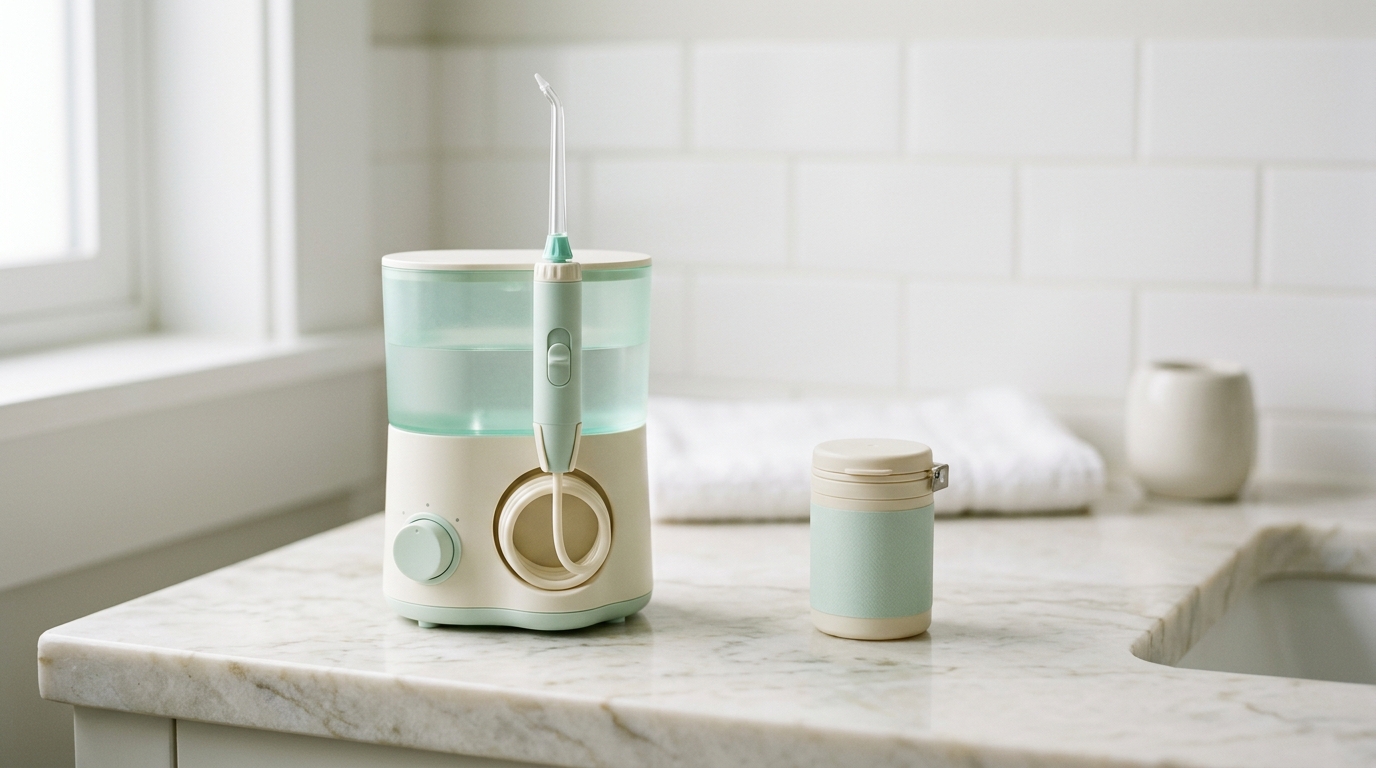
A water flosser cleans by flow and pulsation. It fires a pulsed jet of water along the gumline and into the space between teeth, flushing out food, loosening softer deposits, and disturbing bacteria sitting below the gum edge where no floss reaches comfortably. It also reaches under things: bridges, orthodontic wires, the underside of a fixed retainer.
The distinction that matters most is the contact point, the small area where two neighboring teeth actually touch. It is tight, it is protected from your toothbrush, and it is where cavities between teeth typically begin. Floss passes directly through it. A water jet largely passes around it. That single fact explains most of the disagreement about these two tools.
What the Evidence Actually Supports
Three things are reasonably clear, and it is worth separating them.
First, water flossers do well on gingivitis, inflammation of the gums that shows up as redness, puffiness, and bleeding when you clean. Studies comparing water flossing with string floss have repeatedly found water flossers at least as good, and often better, at reducing bleeding and gum inflammation. That result is consistent enough to take seriously.
Second, the picture on plaque removal is murkier, and it depends on how plaque is measured and where. Floss retains the advantage at the contact point itself. Water reaches more territory but scrubs less.
Third, and least comfortable for everybody: the evidence that string floss prevents cavities between teeth is thinner than its reputation suggests. That is not because flossing does not work. It is because the trials are short, and because most people floss inconsistently and with poor technique, which makes the effect hard to measure. When flossing is done properly it does what it is supposed to do.
Underneath all of this sits the variable that swamps the rest. The best interdental cleaning method is the one you do every day. A water flosser used nightly beats floss used on the third Sunday of the month, comfortably. That is not a technicality. For most people it is the entire answer.
Head to Head
| String floss | Water flosser | |
|---|---|---|
| How it cleans | Scrapes the tooth surface by contact | Flushes and pulses water along the gumline |
| The contact point where teeth touch | Reaches it directly | Passes around rather than through it |
| Under bridges, braces, wires | Awkward, needs threaders | Its strongest use case |
| Below the gumline | Limited, a few millimeters | Reaches deeper, gently |
| Learning curve | Real, most people are taught badly | Almost none, five minutes |
| Time per session | 2 to 3 minutes done properly | About 1 minute |
| Effect on bleeding gums | Good when done well | Consistently good, often noticed quickly |
| Dexterity required | High | Low |
| Mess and setup | None | Splashes, needs a sink and refilling |
| Travel | Fits in a pocket | Cordless models travel, countertop ones do not |
| Upfront cost | Roughly $2 to $6 a spool | Roughly $30 to $150, more for premium models |
| Ongoing cost | Roughly $10 to $40 a year | Roughly $10 to $30 a year for replacement tips |
| Most common failure | Snapping it down onto the gum, or skipping it entirely | Rushing along the arch without pausing between teeth |
These figures are ranges rather than quotes. Where you live, brand, retailer, and whether you buy on sale move them, and a cheap unit that gets used daily is worth more than an expensive one on a shelf.
Who Genuinely Benefits From a Water Flosser
For some people this is a preference. For others it is close to the right clinical answer.
- You wear braces or a fixed retainer. Wires make traditional flossing slow enough that most people abandon it. A water flosser clears brackets and wire in about a minute, and orthodontic tips exist for exactly this.
- You have a bridge. The false tooth in a bridge sits on the gum with no gap to floss through. Water gets underneath it, which is otherwise a job for floss threaders or specialized floss.
- You have implants. The tissue around an implant is more vulnerable to inflammation than the tissue around a natural tooth, and it needs daily cleaning that does not scratch or dig. Water at a low to moderate setting suits that well. Ask your dentist about the right pressure and angle for your particular restoration.
- Your hands do not cooperate. Arthritis, tremor, reduced grip, a shoulder injury, or recovery from a stroke all make the two handed floss maneuver genuinely difficult. This is one of the clearest cases for switching.
- You have gum pockets or a periodontal maintenance schedule. Deeper spaces under the gum are exactly where flushing helps and floss cannot follow.
- You have crowns, veneers, or a lot of dental work with tight or irregular margins that catch floss.
- You have tried to floss for twenty years and never stuck with it. This is not a moral failing. Reach for the tool you will use.
Who Should Keep Using String Floss
Floss remains the better tool if your teeth are tightly packed and healthy, with no dental work and no gum pockets. Tight contacts are the one place water is weakest, and if your gaps are so small that food never packs into them, floss is doing the job that matters most for you.
It also wins for anyone who travels frequently, has no counter space, wants to spend almost nothing, or dislikes the mess. A spool of floss requires no charging, no reservoir, and no maintenance.
If you have healthy gums, no bleeding, no restorations, and a flossing habit that is already solid, buying a water flosser is a comfort upgrade rather than a health one.
The Third Option Most People Are Never Offered
Interdental brushes, small tapered bristle brushes on a handle, sized to fit the gap between two teeth, are the tool that often gets forgotten in this argument. Where the space is big enough to take one, they clean between teeth more effectively than floss does for most people, largely because they are easier to use correctly.
They suit anyone with visible gaps, gum recession, exposed root surfaces, or spaces that trap food. The catch is sizing: too small and it does nothing, too large and you force it and hurt the gum. Ask a hygienist to size you at your next visit. Many people end up needing two or three different sizes for different parts of the mouth, which sounds fussy but takes about a minute in practice.
A realistic setup for a mouth with dental work and a few wider gaps is a water flosser for the general flush plus interdental brushes for the specific spaces that trap food, with floss reserved for the tight contacts at the front.
How to Use a Water Flosser So It Actually Works
Most disappointment with these devices comes from using them like a hose.
- Fill the reservoir with warm water. Cold water on sensitive teeth is unpleasant enough that people quit.
- Start on the lowest pressure setting and work up over a week or two. Higher is not better.
- Lean well over the sink, put the tip in your mouth, then turn it on. Doing it in the other order redecorates the bathroom.
- Keep your lips almost closed and let the water run out into the sink rather than swallowing it.
- Hold the tip at the gumline, angled at roughly ninety degrees to the tooth, and pause for a couple of seconds in each space between teeth rather than sweeping along the arch.
- Work systematically: outside surfaces top and bottom, then inside surfaces, front to back on both sides. Around a minute total.
- Use it before brushing, so the fluoride from your toothpaste is the last thing that touches your teeth.
Replace the tip every three to six months, empty the reservoir between uses rather than leaving standing water in it, and if the gums bleed for the first week, that is usually inflammation announcing itself rather than damage. Bleeding that continues past two weeks of consistent use is worth having looked at.
Frequently Asked Questions
Can a water flosser replace flossing completely?
For many people, yes, in the practical sense that it is what they will use and it visibly improves their gum health. But it is not an identical substitute. If your teeth have tight contacts and you have a history of cavities between them, floss is still doing something the water is not, and using both a few times a week is a reasonable compromise.
Will a water flosser stop my gums bleeding?
It often helps quickly, because most bleeding comes from inflammation caused by plaque sitting at the gumline. Give it two weeks of daily use. If the bleeding persists, or one specific spot bleeds every time, the cause may be tartar under the gum that no home device can remove, and that needs a professional clean.
Are water flossers safe around implants, crowns, and veneers?
Generally yes, and they are frequently recommended for implants specifically. Use a lower pressure setting and avoid blasting straight down into the space between the gum and the restoration. If you have had recent surgery or a new implant placed, check with your dentist before you start.
Should I use it before or after brushing?
Before, in most cases. Clearing the debris first means the toothpaste reaches cleaner surfaces, and it avoids rinsing away the fluoride you just applied. What matters far more than the order is that it happens daily.
My water flosser hurts. Am I doing something wrong?
Usually the pressure is too high, the water is too cold, or the tip is being pushed into the gum instead of held at the edge of it. Turn it down, warm the water, and hold rather than press. Persistent pain in one specific area, rather than general discomfort, is worth mentioning to your dentist.
Do children need one?
Not by default, but they are useful for teenagers in braces, where they are often the only interdental cleaning that gets done at all. Supervise the pressure setting and expect the bathroom to get wet for the first week.
What to Do Next
If you currently clean between your teeth on most days and your gums do not bleed, keep doing what you are doing. Nothing here is a reason to change.
If you have braces, a bridge, implants, or hands that struggle with floss, a water flosser is the practical answer and worth buying now rather than resolving to try harder with string. If your gaps are tight and healthy, spend the money on nothing and keep flossing properly.
And if your gums bleed every time you clean, no purchase settles that on its own. Book a hygiene appointment, ask to be shown on your own mouth which tool suits which gap, and ask to be sized for interdental brushes while you are there. Ten minutes of being shown beats years of guessing at the drugstore.
This article is for general information only and is not a substitute for professional dental advice. Always consult your dentist about your individual needs.