Why Do My Gums Bleed When I Brush?
Bleeding gums are inflamed tissue, not brush damage, which is why brushing less makes it worse. What the bleeding means, when it is not plaque, and when to get it seen.
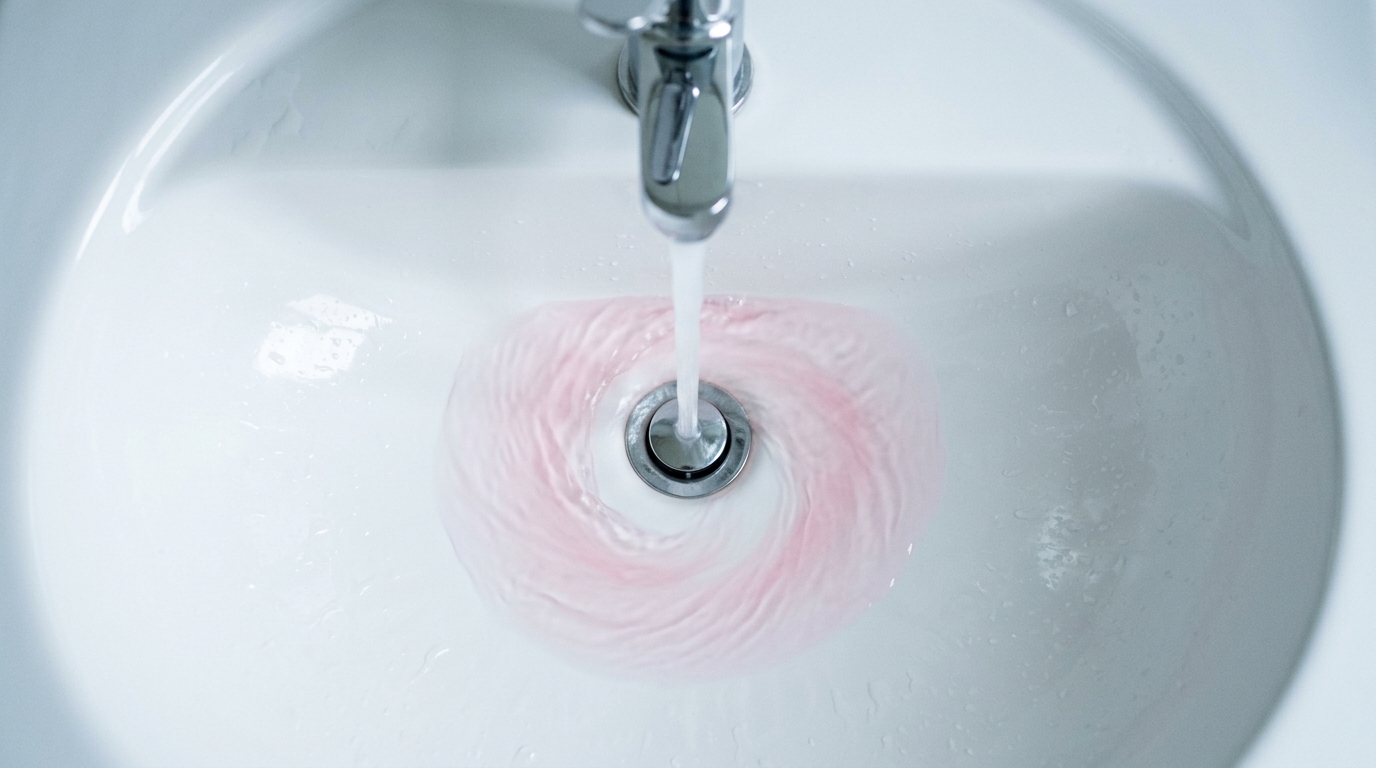
You spat into the sink and the foam was pink. Maybe it happens most mornings, maybe only when you floss between the back teeth, and maybe you have quietly started going easy on that one spot so you do not have to see it.
Here is the thing worth knowing before anything else: healthy gums do not bleed when you clean them. Not a little, not just at the back, not only when you have been busy. Bleeding is almost never the toothbrush being too rough on normal tissue. It is tissue telling you it is already inflamed.
That one fact changes what you should do about it, because the instinct nearly everyone has is to clean the bleeding area less. That is the response that reliably makes it worse. Below is what the bleeding actually is, why the answer is usually more cleaning rather than less, the situations where plaque is not the whole story, and the point at which this stops being a home project.
What the Bleeding Actually Is
Plaque is a soft film of bacteria that rebuilds on your teeth within hours of brushing. When it sits undisturbed in the narrow groove where tooth meets gum, your immune system reacts to it. Blood vessels in the gum widen and multiply close to the surface, the tissue swells, and its lining becomes thin and easily broken.
That is gingivitis: inflammation confined to the gum tissue, with nothing yet lost from the bone underneath. The bleeding is a consequence of that inflammation, not an injury inflicted by your brush. Fragile vessels sitting a fraction of a millimeter below the surface will bleed at the lightest contact. Healthy tissue will not, which is why a hygienist takes bleeding seriously even when you feel fine.
It also makes bleeding genuinely useful information. It is a map. The places that bleed are the places being missed, and most people's map is predictable: between the back teeth, along the inside surfaces of the lower front teeth, and around any crown, bridge, or crowded tooth that is awkward to reach.
Why Brushing Less Is Exactly the Wrong Move
If you skip the area that bleeds, plaque accumulates there undisturbed, the inflammation deepens, and the tissue gets more fragile rather than less. Within a few weeks the spot that bled a little bleeds a lot. People arrive at appointments having successfully trained themselves to avoid one quadrant for years, and that quadrant is invariably the worst one in the mouth.
There is a second reason people stop, and it catches almost everyone: when you start cleaning properly, the bleeding often gets worse for the first few days before it gets better. You are disturbing tissue that was already inflamed. It looks like proof that you are doing damage. It is the opposite. Give it a week and the bleeding usually drops noticeably.
The important distinction is between cleaning more thoroughly and cleaning harder. Pressure does not remove plaque, contact and time do. Scrubbing with a hard brush pushes the gum back permanently and wears a notch into the root, which trades a reversible problem for one that does not grow back. Use a soft brush, angle the bristles into the gum line rather than scrubbing across the flat surface of the tooth, and clean between the teeth daily with floss or interdental brushes, because that is the space a brush physically cannot enter.
Reading Your Own Bleeding Pattern
Not all bleeding gums mean the same thing. Where it bleeds, when it bleeds, and what else is going on with you narrows the list considerably.
| What your bleeding looks like | What it usually points to | What to do about it |
|---|---|---|
| Pink in the sink most mornings, fairly evenly around the mouth | Plaque along the gum line | Two to three weeks of deliberate gum line and interdental cleaning |
| Blood only on the floss, mostly between the back teeth | Plaque in the one space a brush cannot reach | Clean between every day, including the very back surfaces |
| One specific spot bleeds every single time, everything else is fine | A local trigger: tartar, a rough filling edge, a crown margin, trapped food | Have that spot examined rather than scrubbed |
| Bleeding that has not improved after three weeks of genuinely good care | Hardened deposits below the gum line, or a deeper problem | Professional assessment with measurements |
| Gums bleed on their own, with no brushing at all | Substantial inflammation, or a bleeding or clotting issue | Book promptly and mention it when you call |
| Bleeding plus gum tissue visibly growing up over the teeth | Medication induced gum overgrowth | See your dentist and your prescriber together |
| Bleeding that started during pregnancy | Hormones exaggerating the response to the same plaque | Routine dental care, which is appropriate in pregnancy |
| Bleeding since starting a new blood thinner | Existing inflammation made more dramatic by thinner blood | Treat the gums, and never stop the medication yourself |
| Bleeding gums alongside easy bruising or frequent nosebleeds | Possible platelet or clotting problem | See a doctor as well as a dentist |
| Rapid onset pain, ulcerated craters between the teeth, strong odor | An acute gum infection, not ordinary gingivitis | Same week dental care |
Several rows can be true at once, and often are. A pregnant person with a new crown and a flossing habit that stops at the second molar has three things going on.
When It Is Not Just Plaque
Plaque is behind the great majority of bleeding gums, but it is rarely the only variable. These are the ones worth knowing.
Pregnancy. Hormonal changes make gum tissue respond far more strongly to the same amount of plaque, so gums that were fine become swollen and bleed easily, often from the second month onward. Some people develop a soft red lump at the gum edge between two teeth, sometimes called a pregnancy tumor, which is benign and usually settles after the birth. None of this is a reason to postpone dental care. Routine cleanings and examinations are appropriate during pregnancy, and untreated gum inflammation is not the safer option.
Blood thinners and antiplatelet drugs. Anticoagulants, aspirin, and clopidogrel do not cause gum inflammation. What they do is make any inflammation already present bleed longer and look far worse. The mistake to avoid is treating the bleeding as a reason to stop or skip a dose. Do not adjust these medications yourself for any dental reason. Tell your dentist what you take, and if bleeding from a gum does not stop with fifteen minutes of firm pressure on gauze, get advice the same day.
Medications that cause gum overgrowth. Some calcium channel blockers used for blood pressure, some anti-seizure medications, and some immune suppressants used after transplants can make gum tissue grow. The enlarged tissue creates deep folds that trap plaque, so the overgrowth and the bleeding feed each other. It is manageable, sometimes with meticulous cleaning, sometimes by trimming the tissue, and sometimes by a conversation between your dentist and the doctor who prescribes the drug about alternatives.
Vitamin deficiency. Severe vitamin C deficiency genuinely causes spongy, bleeding gums, because vitamin C is required to build the collagen that holds tissue together. It is uncommon in most diets but does turn up in people with very restricted eating, alcohol dependence, some eating disorders, and some absorption problems. This is worth raising with a doctor rather than self diagnosing, and taking large doses of a supplement on a hunch does nothing for gums that are bleeding because of plaque. Severe vitamin K deficiency also affects clotting, but it is rarely the answer to ordinary bleeding gums.
Smoking and vaping. Nicotine narrows the small blood vessels in the gums, so smokers often bleed less while their gum disease progresses faster. Less bleeding is not better gums in that situation. If you smoke and your gums do not bleed, that is not reassurance.
Diabetes. Poorly controlled blood sugar makes gum inflammation worse, and active gum inflammation makes blood sugar harder to control. Gum disease that will not settle despite good care is worth mentioning to whoever manages your diabetes.
Blood disorders. Low platelet counts, clotting disorders, and leukemia can all present with bleeding gums. This is rare, and the distinguishing feature is that the bleeding is not confined to your mouth: unexplained bruising, nosebleeds, bleeding that starts without provocation, or profound fatigue alongside it.
Local mechanical causes. An overhanging filling edge, a crown that sits slightly proud, a partial denture clasp, orthodontic brackets, or two teeth that pack food between them at every meal will keep one site inflamed no matter how well you brush. These need fixing, not more effort.
Genuine brush trauma does exist, but it looks different. It is a discrete cut or scrape in one place that heals within a day or two, not the same tissue bleeding every morning for months.
When to Get Bleeding Gums Looked At
Book an appointment, without running any home experiments first, if you have any of the following:
- Gums that bleed spontaneously, without brushing or eating
- Pus at the gum edge, a gum that hurts to touch, or facial swelling
- A tooth that has loosened, drifted, or changed how your bite feels
- Sudden severe gum pain with ulcerated tissue between the teeth and a strong smell
- Bleeding gums together with bruising or bleeding elsewhere in your body
For everything else, two to three weeks of genuinely consistent cleaning at the gum line and between the teeth is a fair test. If the bleeding stops, you had gingivitis and you have dealt with it. If it does not, that usually means hardened deposits sitting below the gum edge where no toothbrush reaches, and only instruments will remove them. Bleeding that survives good home care is also the main early hint of periodontitis, the stage where the bone supporting the tooth starts to be lost, which is measured with a probe rather than guessed at.
Frequently Asked Questions
Should I stop flossing if it makes my gums bleed?
No. The bleeding is coming from inflamed tissue that needs the plaque removed, so stopping leaves the cause in place and the inflammation deepens. Keep going gently and daily, and expect the bleeding to fade over a week or two.
My gums bled when I flossed for the first time in years. Is that normal?
Very. Tissue that has been inflamed for a long time bleeds readily at the first disturbance, and often bleeds more on days two and three than on day one. What matters is the trend across two weeks, not what happens the first night.
Can bleeding gums be a sign of something serious?
Usually it is gingivitis, which is treatable and reversible. It is worth taking seriously when the bleeding is spontaneous, when you also bruise or bleed easily elsewhere, or when it persists despite good cleaning, because those patterns point to something beyond plaque.
Do I need a special toothpaste or mouthwash for bleeding gums?
An antiseptic rinse can settle inflammation and your dentist may prescribe a short course of a stronger one, but a rinse cannot remove plaque from between teeth or lift hardened deposits off. Use it as a support to mechanical cleaning, never as a substitute for it.
My gums bleed but nothing hurts. Can I leave it?
Gum disease is close to painless until it is advanced, which is exactly why it gets missed. Absence of pain tells you very little here, and bleeding without pain is the classic presentation of a problem that is still easy to fix.
What to Do Next
If the bleeding is new and nothing on the urgent list applies to you, give it a fair trial: soft brush angled into the gum line twice a day, something between every tooth once a day, for two full weeks. Expect the first few days to look worse.
Then check the sink honestly. Clear water means you found the cause and removed it. Still pink means the cause is somewhere your brush cannot go, and the next step is an appointment where someone measures your gums with a probe and looks at an x ray rather than telling you to floss more. Ask for those numbers when you go. They are the difference between a problem you can still reverse and one you can only hold steady.
This article is for general information only and is not a substitute for professional dental advice. Always consult your dentist about your individual needs.