Inlays and Onlays Explained: The Middle Ground Between Fillings and Crowns
Your dentist mentioned an inlay or onlay instead of a crown. What they are, how they differ from fillings and crowns, what the appointments involve, and when they make sense.
Your dentist has looked at a damaged back tooth and said something like: too big for a filling, but you might not need a full crown. Then they mentioned an inlay or an onlay, and you nodded without being quite sure what that meant.
Inlays and onlays sit in the middle of the repair options. They save more of your natural tooth than a crown does, and they are often stronger than a very large filling. They are not right for every tooth, and they are not always offered, but when they fit the situation they are a sensible choice worth understanding.
What Inlays and Onlays Actually Are
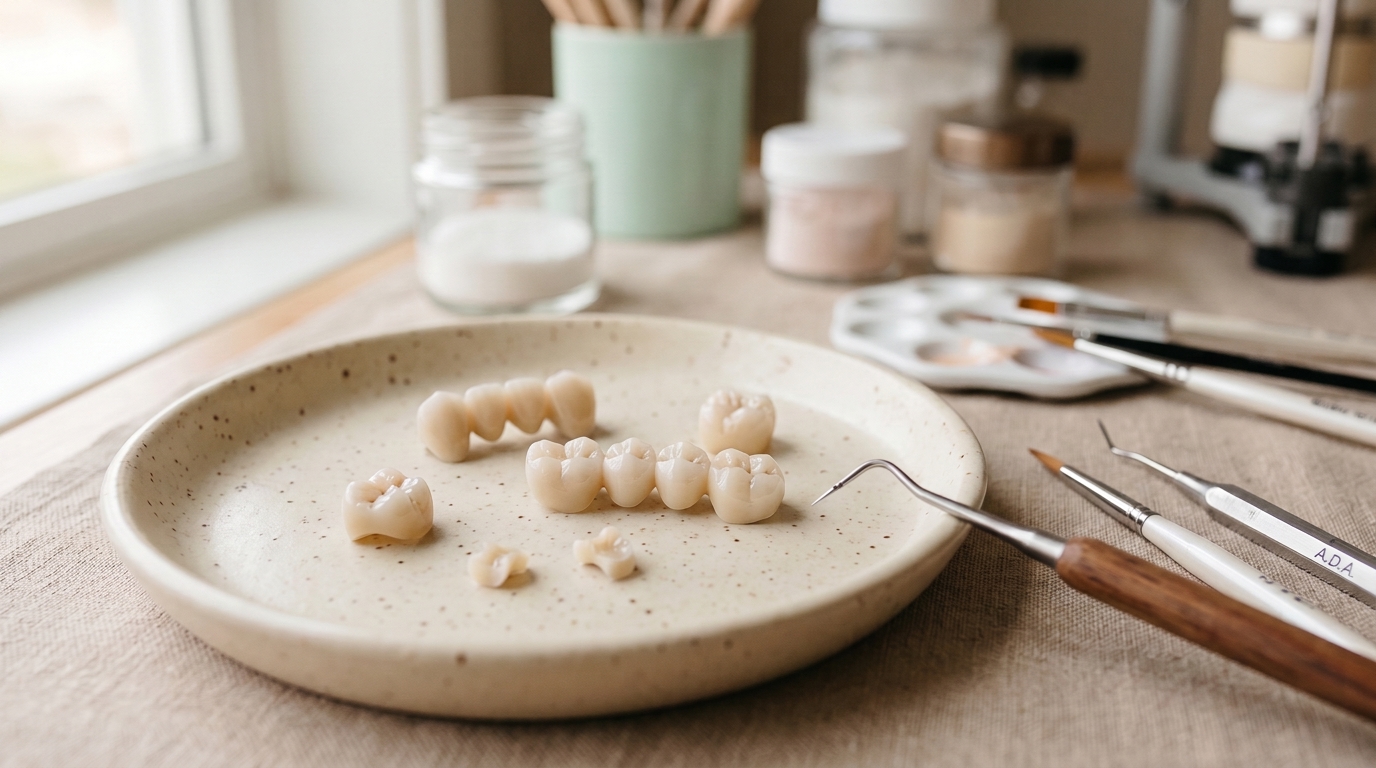
Both are custom made pieces that are shaped outside your mouth, usually in a dental lab or with an in-office milling machine, and then bonded into the tooth. That is the key difference from an ordinary filling, which is soft material placed directly into the tooth and hardened there.
- An inlay fits inside the tooth, within the cusps. The cusps are the raised points on the chewing surface of a back tooth. An inlay fills a hollow between them, a bit like a precisely cut puzzle piece.
- An onlay goes further. It covers one or more of the cusps as well as the space between them. Because it wraps over the top of the tooth, it is sometimes called a partial crown.
A full crown, by comparison, covers the entire visible part of the tooth, which means trimming the tooth down on every side to make room for it.
Filling, Inlay, Onlay, or Crown?
The choice mostly comes down to how much healthy tooth is left and where it is.
| Filling | Inlay | Onlay | Crown | |
|---|---|---|---|---|
| Where it goes | Inside the tooth | Inside, between the cusps | Over one or more cusps | Over the whole tooth |
| Made | Directly in your mouth | Outside the mouth, then bonded | Outside the mouth, then bonded | Outside the mouth, then cemented or bonded |
| Healthy tooth removed | Least | Little | Moderate | Most |
| Best for | Small to medium damage | Medium damage, cusps intact | Larger damage, weak or broken cusps | Extensive damage, cracks, after many root canals |
| Visits | Usually one | One or two | One or two | One or two |
| Relative cost | Lowest | Middle | Middle to upper | Highest, roughly $1,000 to $2,500 |
When an Inlay or Onlay Makes Sense
Your dentist is most likely to suggest one when:
- A filling would be very large. Big fillings put more strain on the remaining walls of the tooth, and those walls can crack over time.
- An old large filling is being replaced. Many people with fillings placed years ago reach a point where the next repair needs to be stronger.
- A cusp has broken but the rest of the tooth is sound. An onlay can replace the broken cusp without trimming the whole tooth for a crown.
- You want to keep as much natural tooth as possible. Once tooth is removed for a crown it does not come back, so a more conservative option keeps more choices open later.
They are less suitable when the tooth is badly cracked, when most of the tooth is already gone, or when there is active gum disease or decay that needs dealing with first. Teeth that have had a root canal often need full cusp coverage, which may be an onlay or a crown depending on how much tooth is left.
What They Are Made Of
- Porcelain or ceramic. Tooth colored, stain resistant, and bonded to the tooth. The most common choice today.
- Composite resin. Tooth colored and generally less costly, but tends to wear and stain more than ceramic over the years.
- Gold. Very durable and kind to the opposing teeth, with a long track record. Less popular now because of the look and the cost of the metal.
Ask your dentist why they suggest a particular material for your tooth, because the best choice depends on where it is, how hard you bite, and whether you grind.
What the Appointments Are Like
The traditional two visit approach
- Preparation. The area is numbed with a local anesthetic, an injection that blocks feeling in that part of the mouth. Old filling material and decay are removed, and the cavity is shaped so the inlay or onlay can slide in.
- Impression or scan. The dentist takes a mold or a digital scan of the prepared tooth.
- Temporary. A temporary filling protects the tooth while the lab makes the final piece, usually over one to three weeks.
- Fitting. At the second visit, the temporary comes out, the inlay or onlay is tried in, checked for fit and bite, then bonded in place and polished.
Same day options
Some offices use a scanner and an in-office milling machine to design and cut a ceramic inlay or onlay in a single appointment. That saves a visit and a temporary, though not every practice offers it.
How it feels
Most people find the appointment similar to having a filling, just a bit longer. Mild sensitivity to cold or biting for a few days afterward is common and usually settles on its own. If your bite feels high, call the practice, because a quick adjustment usually fixes it.
How Long Inlays and Onlays Last
Well made ceramic and gold inlays and onlays commonly last many years, often longer than large fillings, because they are made from stronger material and shaped precisely before they go in. How long yours lasts depends on how well you clean around the edges, whether you grind your teeth, your diet, and how much healthy tooth supports it.
Decay can still start at the edges, so brushing twice a day with fluoride toothpaste, cleaning between your teeth, and keeping up with checkups matter as much as with any filling. If you grind at night, a night guard can protect the restoration and the teeth around it.
Caring for an Inlay or Onlay in the First Weeks
For the first day, while any numbness wears off, avoid chewing on that side so you do not bite your cheek or tongue. After that you can eat normally, though it is sensible to go easy on very hard foods such as ice, hard sweets, and popcorn kernels for a week or so while you get used to the new surface.
Some points are worth knowing:
- Floss normally. Bonded inlays and onlays are firmly attached, and cleaning the edges is exactly what keeps them healthy. If floss shreds or catches on an edge, mention it at your next visit.
- Expect your tongue to notice it. Any new restoration feels different for a few days. If it still feels rough or high after a week, a quick polish or adjustment usually helps.
- Watch for lingering sensitivity. Short twinges with cold that fade over a couple of weeks are common. Pain that gets steadily worse, throbs, or wakes you at night is not, and should be checked.
- Tell your dentist if you grind. Grinding is one of the main reasons ceramic restorations chip. A custom night guard typically costs $300 to $800 and protects both the restoration and your other teeth.
Inlays and Onlays vs Just Waiting
Sometimes the honest choice is between a planned onlay now and a bigger repair later. A cracked cusp or a very large old filling rarely improves with time. If the remaining walls of the tooth break, the repair that was possible with an onlay can become a crown, and a crack that reaches the nerve can mean a root canal first. Waiting is reasonable for a stable tooth with no symptoms, but ask your dentist what they would expect to happen if you do, and how soon.
Cost and Insurance
Inlays and onlays are usually priced above a large filling and below a full crown, which typically runs about $1,000 to $2,500 depending on material. The exact fee depends on the material, whether the work is done in a lab or the office, and where you live. Ask for a written estimate before you agree.
Many dental plans treat inlays and onlays as major work, which commonly means the plan pays around half after the deductible, up to the annual maximum. Some plans pay only what they would for a filling and leave you the difference, so check before treatment. The free dental insurance estimator shows how a typical plan splits the cost, and the dental cost calculator gives crown ranges for your area if you are comparing options.
These are ranges, not quotes. Location, materials, and the complexity of your tooth all move the price.
Frequently Asked Questions
Is an onlay better than a crown?
It is not better in every case, but it is more conservative. An onlay keeps more of your natural tooth, which is good for the long-term health of the tooth. If the tooth is cracked or very broken down, a crown usually protects it better.
Does getting an inlay or onlay hurt?
The tooth is numbed first, so you should feel pressure rather than pain. Afterward, mild sensitivity for a few days is common. Pain that is strong, lingers after hot or cold, or keeps getting worse should be checked.
Why did my dentist suggest a crown instead?
Usually because there is not enough healthy tooth left for an onlay to hold well, or because there is a crack that needs the whole tooth braced. Ask them to show you the x-ray or photo and explain what they saw.
Can an inlay or onlay be done on a front tooth?
They are designed for back teeth with cusps. Front teeth are usually repaired with bonding, veneers, or crowns, depending on the damage.
How do I know if my inlay or onlay has failed?
Signs include a gap or rough edge your tongue can feel, food catching where it did not before, new sensitivity, or a piece coming loose. Book a visit if you notice any of these.
What to Do Next
If your dentist has suggested an inlay or onlay, ask three questions: why this rather than a filling, why this rather than a crown, and which material they recommend for your tooth. Ask to see the x-ray or photos.
Get a written estimate and check what your plan pays. If it is a large old filling being replaced, our guide to dental fillings explains why fillings eventually wear out. A good dentist will be happy to explain the options, and a choice that keeps more of your own tooth is usually worth considering.
This article is for general information only and is not a substitute for professional dental advice. Always consult your dentist about your individual needs.