Periodontitis Explained: Pockets, Bone Loss, and What Treatment Can Hold
Periodontitis is the stage where gum disease reaches the bone. What the probing numbers mean, why the damage does not reverse, and what good treatment realistically achieves.
Someone read numbers out loud while you sat in the chair. Three, three, four. Four, five, five. Then a word you had not heard before, or had heard and assumed meant the same thing as bleeding gums.
Periodontitis is not a worse version of gingivitis. It is a different situation, and the difference is specific: the bone that holds your teeth in has started to be lost, and bone that is gone does not come back. That sounds alarming, and the first thing to say is that most people who hear this diagnosis do not lose teeth. They get it stopped.
But you cannot make good decisions about it without understanding what is actually being measured and what treatment can and cannot deliver. So here is the mechanism, the numbers, the honest limits, and what stable looks like.
What Periodontitis Actually Is
Each tooth sits in a socket in the jawbone, held there by the periodontal ligament, a layer of fibers that anchor into the bone on one side and into the root surface on the other. Around the top of that arrangement, gum tissue forms a shallow cuff against the tooth, like the elastic top of a sock.
In gingivitis, bacteria at the gum line inflame that cuff. The gums bleed, nothing hurts, and the ligament and bone are untouched. Remove the plaque and the tissue returns to normal.
In periodontitis, the inflammation has moved down past the cuff. The fibers that attached to the root detach, the bone edge closest to the irritation resorbs away, and the shallow cuff becomes a deep crevice, called a pocket, that runs alongside the root. That pocket is now a sheltered space. It holds bacteria that no toothbrush or floss can reach, so the process feeds itself.
The counterintuitive part is what does the damage. The bacteria are not eating your bone. Your own immune response to the persistent bacterial presence is what breaks down the ligament and moves the bone away from the irritant. That is why periodontitis is so variable between people with similar plaque levels, and why factors that alter your immune response, like smoking and diabetes, matter so much.
What "Bone Loss" Really Means
The word makes people picture a hole. It is closer to a shoreline retreating.
Bone loss in periodontitis is measured as a reduction in the height of the bone around a root. If a tooth's root is fifteen millimeters long and bone has receded three millimeters from the top, roughly a fifth of that tooth's support is gone. The tooth is still solid, still functional, still not painful. It just has less socket than it started with, and its long term outlook now depends on whether the loss keeps going.
Dentists describe the pattern in two shapes. Horizontal bone loss takes the bone level down fairly evenly across a region, like a tide going out. Vertical bone loss, also called an angular defect, carves a deeper trench beside one root while the neighboring bone stays higher. The distinction matters practically: some contained vertical defects can be partly rebuilt with grafting, while horizontal loss cannot be reversed at all.
You will not feel any of this happening. There is no ache when a millimeter of bone goes. Symptoms appear late, once so much support is gone that a tooth loosens, drifts, or a gum abscess forms. This is the whole reason gum disease is screened for with a probe and x rays instead of by asking whether it hurts.
What the Numbers Mean When They Measure Your Gums
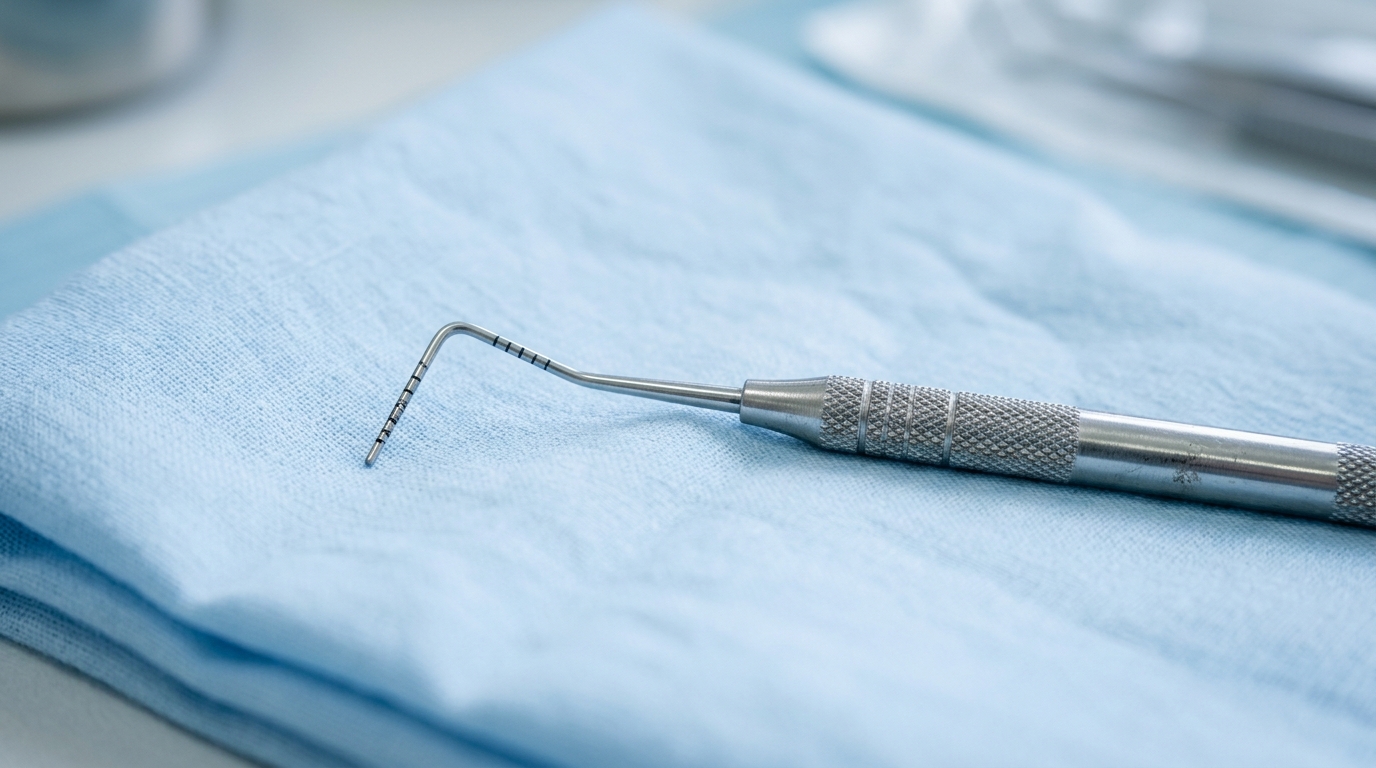
The probing depth is how far a thin blunt probe slides into the crevice between gum and tooth before it meets resistance, in millimeters, measured at six points around every tooth. Your dentist records one more thing at each site: whether it bleeds when probed, which marks active inflammation rather than old damage.
| Number called out | What it usually means | Typical response |
|---|---|---|
| 1 to 3 mm, no bleeding | Healthy. This is what a normal cuff measures | Regular checkups and cleanings |
| 1 to 3 mm with bleeding | Gingivitis. Inflamed but no attachment lost yet | Better home care, routine clean, reversible |
| 4 mm with bleeding | Early breakdown, or swelling creating a false pocket | Deep cleaning of that area, then recheck |
| 5 to 6 mm | Established periodontitis. Beyond what you can clean at home | Scaling and root planing, risk factor control |
| 7 mm and above | Advanced. Often with bone loss visible on x ray | Specialist assessment, likely surgery |
| Any depth plus mobility or a furcation reading | Support loss affecting the tooth's stability | Detailed prognosis discussion per tooth |
Two other measurements go alongside. Recession is how far the gum has moved down the root, and it matters because a deep pocket on a tooth with recession represents much more total loss than the pocket depth alone suggests. Added together they give clinical attachment loss, which is the honest total of how much support that tooth has lost, and it is the number periodontists actually care about. A 4 mm pocket on a tooth with no recession and a 4 mm pocket on a tooth with 3 mm of recession are not the same tooth.
Furcation involvement is when bone loss reaches the point where the roots of a molar divide. Once a probe can enter that junction, the tooth has an internal space that no cleaning instrument fully reaches, which is why molars with furcation involvement have a harder outlook than single rooted teeth with the same pocket depths.
Staging and Grading, in Plain Words
You may see a stage and a grade written on your chart. They answer two different questions.
Stage describes how much damage is already done and how complicated the repair is: from early attachment loss confined to a few sites, through moderate loss, to advanced loss with the potential for tooth loss, up to the point where enough teeth have been lost that chewing function and bite stability are affected. Stage does not go backward. It is a record of accumulated history.
Grade describes how fast it is moving, and this is the number that predicts your future. A slow grade means the damage you have took decades to accumulate. A rapid grade means significant loss in a person young enough or clean enough that it should not be there yet. Smoking and poorly controlled diabetes both push the grade upward, which is a formal way of saying that they make the disease progress faster in the same mouth.
Two people can both have moderate periodontitis and face completely different futures depending on grade. That is why the diagnosis alone tells you less than the trajectory does.
Why Periodontitis Does Not Reverse
Three things were lost: the bone, the ligament fibers that inserted into it, and the specific attachment of those fibers to the root surface. The body does not spontaneously rebuild that arrangement once chronic inflammation has broken it down. Healing after treatment produces a scar like seal against the root rather than a restored ligament.
There are real exceptions with real limits. Regenerative procedures, using bone grafting material and a membrane, can rebuild part of the lost support in specific anatomies, mainly narrow vertical defects with walls of remaining bone around them to contain the graft. That is a genuine option worth asking about if you have that shape of defect. It is not a general undo button, and no procedure regrows evenly lost bone across a whole arch.
There is also an expectation to set before treatment rather than after. When deep cleaning resolves the inflammation, the swollen gum tissue shrinks back against the tooth. Your pockets get shallower partly because the gum has tightened down. That is success, and it can also mean teeth look longer, small triangular gaps open between them, and roots become sensitive to cold. People sometimes feel worse cosmetically at the exact moment they got better biologically. Knowing that in advance takes most of the sting out of it.
What Treatment Actually Holds It At
The goal of periodontal treatment is not cure. It is stability: no bleeding when the sites are probed, pockets brought down to shallow depths that you can clean at home, and no further attachment loss over time. A stable mouth with previous bone loss can function for decades.
The sequence usually looks like this.
First, cause related therapy. Removing the deposits from the root surfaces below the gum, which is scaling and root planing, plus getting the home routine to a standard that keeps those surfaces clean afterward, plus addressing the risk factors that alter your immune response. The most important of those is smoking, and the honest version is that a smoker's response to periodontal treatment is worse than a non smoker's with the same disease. Quitting is not a lifestyle suggestion in this context, it is part of the treatment.
Then reassessment. Six to twelve weeks later, everything is measured again. Sites that responded stay on maintenance. Sites that did not respond, usually deep pockets and furcations, are the ones that get considered for surgery.
Then surgery, if it is needed. Flap surgery lifts the gum to give direct access to root surfaces that instruments could not reach blind, and bone can be reshaped or grafted at the same time. It is done by quadrant or sextant under local anesthetic, and it is usually reserved for the sites that failed to settle rather than done everywhere by default.
Then maintenance, permanently. This is where periodontitis is won or lost. Pockets repopulate with bacteria within a matter of months, so periodontal maintenance runs every three to four months rather than every six. People who keep those appointments hold their teeth at rates that look nothing like people who drift back to twice yearly cleanings. If you take one practical thing from this page, take that.
The detail of what those cleaning appointments involve is covered separately, including how they are split up and what they cost.
When a Tooth Cannot Be Held
Some teeth are past saving, and it is better to know early. The signs that a tooth has a poor outlook include mobility that keeps increasing, bone loss past most of the root length, deep furcation involvement in a molar, a vertical defect that keeps deepening despite treatment, and repeated abscesses at the same site.
Removing such a tooth deliberately, rather than waiting for it to fail on its own, is often the better call. Ongoing infection continues to consume the bone around it, and that bone is exactly what an implant or bridge would need later. Extracting earlier tends to leave more to work with.
Frequently Asked Questions
Can periodontitis be cured?
Not in the sense of undoing it. It can be arrested, meaning the inflammation resolves, pockets shrink, and the bone level stops dropping. That is a realistic and common outcome, and it is what treatment is aiming for.
How fast will I lose my teeth?
For most people with treated, maintained periodontitis, the answer is that they do not. Progression depends far more on grade, smoking, diabetes control, and whether you attend maintenance than on how bad the numbers looked on day one.
My gums stopped bleeding. Does that mean it is gone?
Not necessarily. No bleeding on probing is a good sign and a genuine treatment goal, but the pocket depths and bone levels still need checking, and smokers in particular can have suppressed bleeding while disease continues. Judge it by the full set of measurements.
Is periodontitis genetic?
Susceptibility runs in families, and some people mount a more destructive inflammatory response to the same bacteria than others. That does not make it inevitable, because the bacteria are still the trigger, and controlling them is still what changes the outcome.
Do my teeth being loose mean they will fall out?
Not automatically. Some looseness resolves as inflammation settles and the ligament recovers tone, and teeth can be splinted together for support. Mobility that keeps increasing after treatment is the version that predicts loss.
Will my breath improve with treatment?
Usually yes. Deep pockets shelter bacteria that produce the sulfur compounds behind persistent bad breath, so cleaning them out often makes a noticeable difference.
What to Do Next
Ask for your chart. Not a summary, the actual numbers: your deepest pockets, how many sites bleed, whether there is furcation involvement, and what percentage of bone loss the x rays show. Then ask the question that matters most: what is my grade, meaning how fast has this been moving?
If you have not been referred and your pockets are deep or your molars are involved, ask whether a periodontist should see you. And whatever the plan turns out to be, book the maintenance appointments before you leave. Periodontitis is not an event you get treated for once. It is a condition you keep stable, and the interval is the treatment.
This article is for general information only and is not a substitute for professional dental advice. Always consult your dentist about your individual needs.