Receding Gums: What Causes Them, and What Can Actually Be Done
Gum recession does not grow back on its own, but it can almost always be stopped. Here is what causes it, how it is measured, and what each treatment really does.
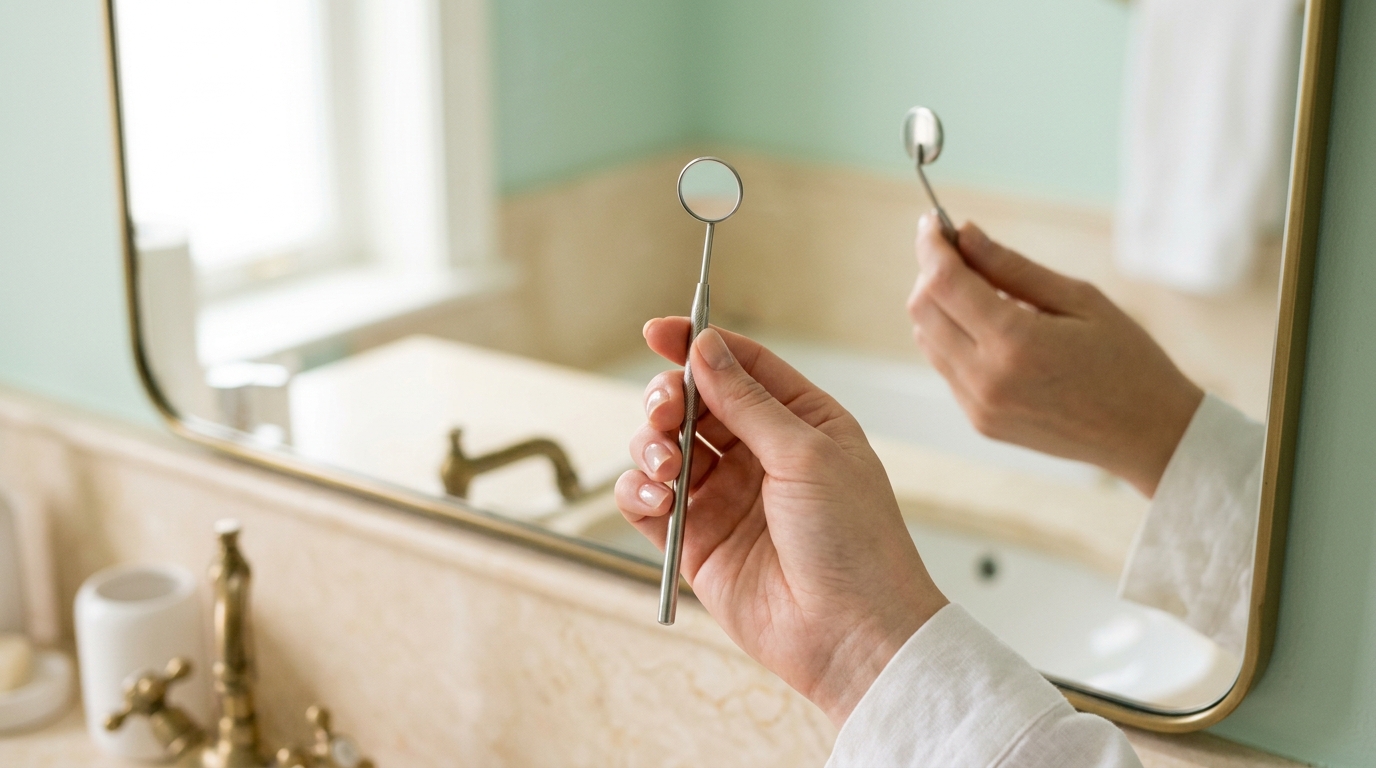
You looked in the mirror and one tooth looks longer than the one beside it. Or your fingernail caught a small notch at the gumline. Or cold water hits one particular spot and you flinch, every single time.
Here is the blunt part first, because you are going to read it somewhere anyway. Gum tissue that has pulled back does not grow forward again by itself. No toothpaste, oil, gel, or rinse regrows it. For the tissue you have already lost, that is genuinely the situation.
Now the useful part. Recession is nearly always driven by something specific and identifiable, and once you take that thing away, it usually stops. Most people who notice it do not need surgery. They need to find the cause, stop it, and deal with the sensitivity. This covers how to work out which cause is yours, how a dentist measures whether it is progressing, and what each treatment actually does, from changing your toothbrush all the way up to grafting.
What gum recession actually is
Gingival recession means the gum margin, the scalloped edge where gum meets tooth, has moved toward the root and uncovered root surface that used to be protected.
To see why that matters, it helps to know your tooth has two different outer materials. Above the gumline, the crown is covered in enamel, the hardest substance in your body, glassy and effectively sealed. Below the gumline, the root is covered in cementum, a far thinner and softer layer that was never designed to sit exposed in the open mouth. Cementum wears away easily, and beneath it is dentin, a living tissue threaded with microscopic tubules that run inward toward the nerve.
That is the whole story of recession in one paragraph. You have traded a hard, sealed surface for a soft, porous, nerve-connected one.
Why receding gums do not grow back
The height of your gum is set by the height of the bone underneath it. Gum drapes over bone rather like a fitted sheet, sitting a fairly predictable distance above it. Where bone has been lost, or where it was thin or missing over that root to begin with, the gum has nothing to sit on and settles lower. Bone does not spontaneously rebuild over an exposed root, and gum will not climb back up a root it has already let go of.
One thing does look like regrowth, and it is worth knowing about. Inflamed gums swell, and swollen gum sits higher on a tooth than healthy gum. Treat the inflammation and the swelling goes down, which can make recession look worse in the weeks after a deep cleaning. That is not the cleaning damaging your gums. It is the true position becoming visible for the first time.
What causes receding gums
Most people have two or three of these running at once, which is why finding a single culprit can be frustrating.
Periodontal disease is gum infection that has progressed to destroy the bone around teeth. It is the most consequential cause on this list, because here the recession is a symptom of ongoing bone loss rather than a surface problem. It tends to affect many teeth, comes with bleeding, and shows up on X-rays.
Brushing too hard, with the wrong brush. Enamel does not care much, but the gum margin does, and so does the softer root surface once it is exposed. The pattern is distinctive: recession on the cheek side of the teeth, often worse on the side opposite your dominant hand, frequently with a smooth wedge-shaped notch worn into the tooth at the gumline. Splayed, flattened bristles on your brush are the giveaway.
A thin gum biotype. Your periodontal biotype is simply how thick your gum tissue and the bone under it naturally are, and it is inherited. Thin biotypes look delicate, sometimes translucent enough that you can see the shape of the root through them, and they recede more readily under any given amount of stress. You cannot change this. You can allow for it.
Grinding and clenching. Bruxism is involuntary grinding or clenching, usually at night. Heavy repeated loading flexes the tooth at the neck and appears to contribute to both notching and recession on the teeth taking the most force, though it is rarely the only thing going on.
Orthodontic movement. Teeth move through bone, and bone is only so thick. Push a tooth toward the outside of its bony housing, particularly a lower front tooth in a narrow jaw, and the bone over the root can thin or disappear, taking the gum with it. This is not a reason to avoid straightening your teeth, but it is a reason to raise thin gums with your orthodontist before treatment starts.
Tobacco in any form. Smoking impairs the gum's blood supply and its ability to heal. Smokeless tobacco, snuff, and nicotine pouches cause a very localized recession exactly where the product is habitually parked.
Lip and tongue piercings. Metal jewelry rubs the same strip of gum thousands of times a day, every time you talk or swallow. The recession is typically a neat band directly behind the lower front teeth or in front of them, and it can be dramatic and fast in young, otherwise healthy mouths.
Less common contributors include a frenum, the small band of tissue connecting lip to gum, attached high enough to tug on the margin, metal clasps on a partial denture resting on the gum, and a long habit of picking at the gums with fingernails or wooden toothpicks.
Matching your recession to its cause
| Likely cause | What points to it | What stops it |
|---|---|---|
| Periodontal disease | Bleeding gums, bad taste, deeper pockets, recession across many teeth, bone loss on X-rays | Cleaning below the gumline, then daily interdental cleaning and regular maintenance |
| Aggressive brushing | Cheek-side recession, wedge-shaped notches, flattened bristles, worse on one side | Soft brush, pen grip, electric brush with a pressure sensor, low-abrasion paste |
| Thin gum biotype | Delicate translucent gums, roots visible through tissue, little inflammation | Cannot be changed, so protect it and consider grafting if it progresses |
| Grinding or clenching | Flat worn edges, morning jaw ache, cracked fillings, recession on the load-bearing teeth | Night guard, plus addressing the clenching itself |
| Orthodontic movement | Appeared during or after braces or aligners, usually lower front teeth | Review with the orthodontist, sometimes grafting before further movement |
| Tobacco or nicotine pouches | Recession focused where the product sits, plus staining | Stopping, which also improves how the gums respond to everything else |
| Lip or tongue piercing | A clean band of recession right where the jewelry rests | Removing the jewelry, because the mechanical rubbing never stops otherwise |
| Tooth sitting outside its bone | One crowded or rotated tooth, very thin bone over the root | Orthodontic repositioning, grafting, or monitoring and accepting it |
| Partial denture clasp | Recession precisely where a metal clasp contacts the gum | Redesigning the denture |
More than one line can be true at once, and usually is. Use this to narrow the conversation with your dentist rather than to diagnose yourself.
How recession is measured
This matters more than it sounds, because the number is how you find out whether you have a problem that is over or a problem that is still moving.
Your dentist measures from the cementoenamel junction, the faint line where enamel ends and root begins, down to the current gum margin, in millimeters. One millimeter is barely visible. Three is obvious in a mirror. Five and above usually brings symptoms.
Two other numbers get recorded alongside it. Probing depth is how deep a fine probe slides into the crevice between gum and tooth before it meets resistance. Clinical attachment loss adds recession and probing depth together, and it is the honest total of how much support that tooth has lost. A tooth with 3 mm of recession and shallow, healthy pockets is in a very different position from a tooth with 3 mm of recession and 5 mm pockets.
Dentists also classify recession by whether the gum and bone between the teeth are still intact. That distinction is the single best predictor of how much root a graft could realistically cover. Where the tissue between the teeth is healthy, full coverage is often achievable. Where it has been lost, partial coverage is the realistic goal, and no surgeon can promise more.
The most valuable tool, though, is repetition. Recession measured once is a snapshot. The same measurements and photographs six or twelve months later tell you whether the cause has actually been removed.
What recession costs you if you leave it
Sensitivity is usually the first complaint. Exposed dentin tubules carry fluid, and cold, sweet, or touch stimuli make that fluid move, which the nerve reads as a sharp jolt. It is real, not imagined, and it is treatable.
Root decay is the underrated one. Root surface is softer than enamel and dissolves at a milder level of acidity, so a root cavity can form under conditions that enamel would shrug off. Root decay near the gumline is also awkward to fill and can undermine a tooth quickly. If you have recession and a dry mouth, this risk climbs steeply.
Notching and wear at the gumline can deepen to the point where the tooth becomes structurally weak, and occasionally to the point where the notch reaches the nerve.
Appearance is a legitimate reason to treat. Long teeth, dark triangles between them, a visible color change at the gumline, or the metal edge of an old crown coming into view all bother people, and that is reason enough to discuss it.
Step one, always: stop the cause
Nothing else on this page works if the thing driving the recession is still running.
- Switch to a soft or extra-soft brush and hold it in a pen grip rather than a fist. An electric brush with a pressure sensor is the easiest way to retrain a heavy hand, since it tells you off in real time.
- Stop scrubbing horizontally. Small circles or short angled strokes at the gumline, without force.
- Use a lower-abrasion toothpaste. Whitening pastes are generally the most abrasive shelf category, and abrasion matters far more on exposed root than on enamel.
- If your gums bleed, get them treated. Home care cannot reach into a pocket.
- If you clench or grind, get a night guard made.
- If you have a lip or tongue piercing sitting against your gums, take it out. This one is not negotiable if you want the recession to stop.
- Stop tobacco and nicotine pouches.
Treating the sensitivity while you decide
Most recession needs symptom control rather than surgery, and the tools are decent.
Potassium nitrate toothpastes work by calming the nerve response rather than sealing the tooth, and they need a couple of weeks of consistent use before you judge them. Stannous fluoride and arginine pastes work the other way, by physically plugging the open tubules. Many people do best alternating or using one that combines approaches.
Use a pea-sized amount, brush gently, and spit rather than rinsing so the active ingredient stays on the tooth. Rubbing a smear directly onto the sensitive spot with a fingertip before bed helps. Your dentist can also apply a desensitizing varnish, a fluoride-rich coating painted onto the root that lasts weeks to months, and can prescribe a high-fluoride toothpaste that both reduces sensitivity and protects against root decay.
Cut back on rinsing your mouth with acidic drinks, and do not brush straight after them.
When bonding fixes it
If recession has left a defined notch, a dentist can fill it with composite, tooth-colored resin bonded into place. It seals exposed dentin, ends the sensitivity almost immediately, restores the tooth's shape, and takes under an hour with little or no drilling.
What it does not do is bring the gum back. It fills the tooth, not the space where the gum used to be. The margin can pick up stain over the years and may need refreshing, and a composite built too bulky makes the area harder to clean, which creates a new problem. It is an excellent answer to sensitivity and notching, and a partial answer to appearance.
Gum grafting
Grafting is the only predictable way to get real tissue back over an exposed root.
A connective tissue graft takes a thin layer of tissue from under the surface of your palate and tucks it under a flap of gum raised over the recession, with the overlying gum then pulled down and stitched over it. It is the most reliable option for root coverage and for adding thickness to a thin biotype, and it blends well because it is your own tissue.
A free gingival graft takes the full thickness including the surface layer. It builds a strong band of tough gum, which is its main purpose, but the color match is often noticeably paler, so it is used more where durability matters than where appearance does.
An allograft uses processed donor tissue instead of your own palate, which spares you the second surgical site. Coverage results are respectable, though thickness gained is generally less than with your own connective tissue.
Recovery is more manageable than people expect. The graft site itself is usually not the sore part. The palate donor site is, and it typically settles over about a week, protected by a dressing or a small plate. You will eat soft food, avoid brushing the site for a couple of weeks, and keep stitches for one to two weeks. Judging the final appearance takes a few months, as the tissue matures and settles.
The pinhole technique
The pinhole surgical technique takes a different route. Instead of cutting a flap and transplanting tissue, the surgeon makes a small entry hole above the recession, uses specially shaped instruments to loosen the gum from the bone, and slides the whole band of tissue down over the exposed roots. Collagen strips are tucked in to hold the new position. There are no scalpel incisions across the gum and no sutures, and several teeth can be treated in one sitting.
The appeal is obvious: less discomfort, no palate wound, faster recovery, and a full arch treated in one visit. The honest limits are worth stating too. It moves the tissue you already have rather than adding new tissue, so it does not thicken a genuinely thin biotype the way a connective tissue graft does. It needs enough healthy attached gum to work with. Results depend heavily on the operator's experience. And its long-term track record is shorter than that of connective tissue grafting, which has decades behind it.
What treatment tends to cost
A desensitizing varnish appointment is often somewhere around $25 to $75. Composite bonding at the gumline commonly runs about $150 to $450 per tooth. Deep cleaning for gum disease is frequently about $200 to $500 per quadrant of the mouth. A connective tissue graft is often in the region of $600 to $1,500 per tooth, and pinhole treatment across a section of several teeth commonly lands somewhere between about $1,000 and $3,500.
These are ranges rather than quotes. Your location, the materials used, how many teeth are involved, whether a specialist does the work, and the complexity of your case all move them significantly, and your insurance may treat grafting as a functional rather than cosmetic procedure if sensitivity or root decay is documented.
Frequently asked questions
Can receding gums grow back naturally?
No. Gum tissue does not regenerate over an exposed root surface on its own, and no product regrows it. Recession can be stopped, the sensitivity can be treated, and coverage can be restored surgically, but nothing you buy will bring the gum back up the tooth.
Is it too late if my gums have already receded?
Almost certainly not. Stopping the cause protects everything you still have, which is the part that matters most. Even substantial recession is compatible with keeping your teeth for life as long as the underlying bone is stable and you can keep the area clean.
Can an electric toothbrush cause receding gums?
Used properly, an electric brush is usually gentler than a manual one, because you guide it rather than scrub with it and most models limit or warn about pressure. The damage comes from force and from hard bristles, not from the motor. If you press hard enough to stall the head, you are pressing far too hard.
How quickly do gums recede?
It varies enormously by cause. Recession from a lip piercing or a rapid orthodontic movement can be visible within months. Recession from brushing habits or a thin biotype usually creeps along over years, which is exactly why comparing measurements at successive check-ups is more informative than staring in the mirror.
Will I lose the tooth?
Recession by itself does not cost you a tooth. Recession that comes with progressive bone loss from periodontal disease can, over time. That is why the pocket depths matter as much as the recession, and why gum disease is the one cause on this list you should not delay treating.
Should I get a graft for appearance alone?
You can, and many people do. It is worth asking your dentist specifically how much coverage is realistically achievable on your teeth, since that depends on whether the gum and bone between the teeth are intact. A clear answer up front prevents disappointment later.
What to do next
Take a photograph of the area today, straight on and in good light, and put a date on it. That single act turns a vague worry into something you can track.
Then book an examination and ask for three things: your recession measurements in millimeters, your pocket depths, and a straight opinion on what is causing it. If the answer is brushing, change your brush and your grip this week. If the answer is gum disease, treat it now rather than in a year. If the answer is a piercing, take it out.
Grafting and pinhole surgery are real options and they work, but they are the second conversation, not the first. Stop the cause, control the sensitivity, and give yourself six months of measurements. Then decide whether you want coverage back, with a much clearer idea of what you are buying.
This article is for general information only and is not a substitute for professional dental advice. Always consult your dentist about your individual needs.