Tongue Scraping: Does It Work, and How to Do It
Tongue scraping genuinely helps with breath, modestly, and does little else. Here is what the evidence supports, how to do it without gagging, and when a coating needs looking at.
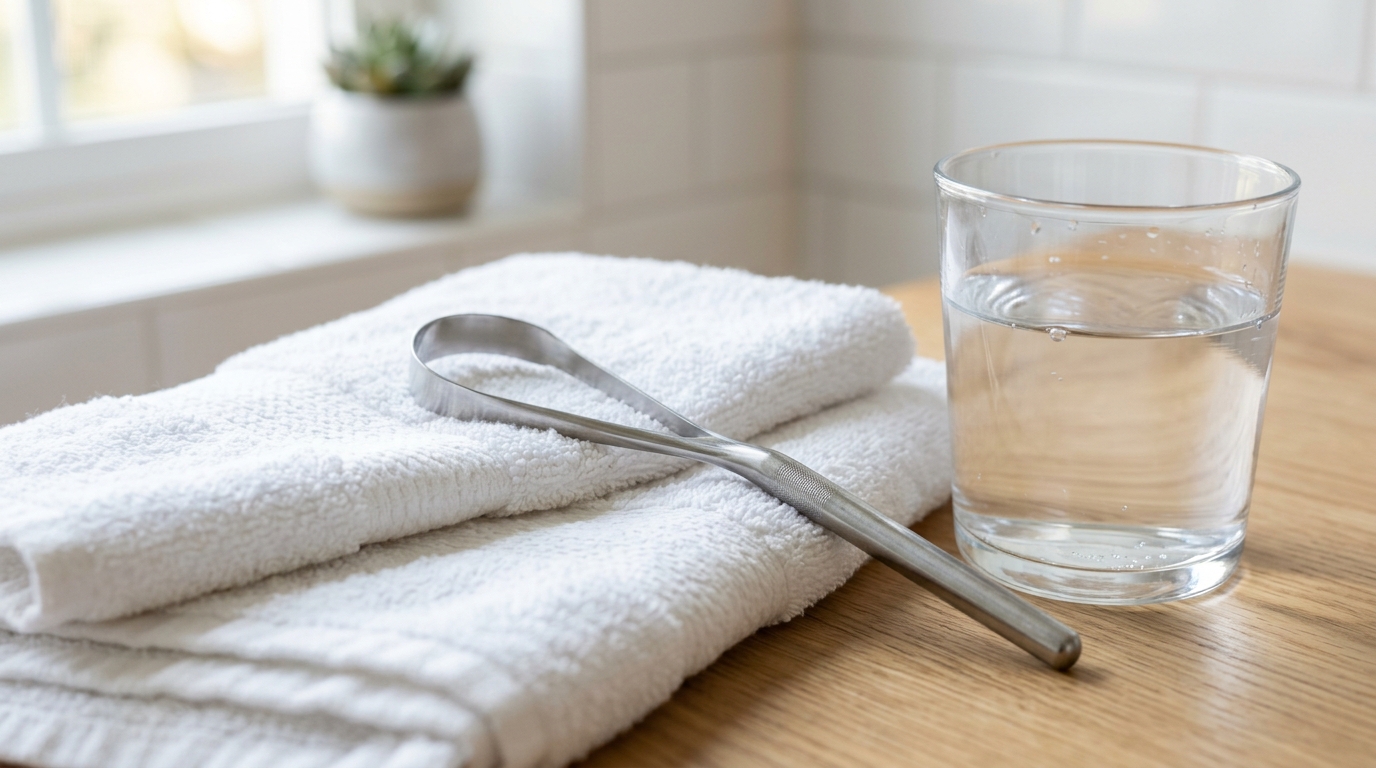
You have seen the white or yellowish film on the back of your tongue in the mirror, and you have seen people online insisting that scraping it off will change your life.
The honest answer is narrower than that, and more useful. Tongue scraping works for breath. It works modestly, it works only while you keep doing it, and there is little evidence it does much else. That is still worth fifteen seconds a day, because breath is the thing most people are actually trying to fix.
Here is what the coating is, what the research supports, how to do it without triggering your gag reflex, and the small number of situations where a coating on the tongue means something and needs looking at.
What the Coating Actually Is
The surface of your tongue is not smooth. It is covered in papillae, small raised projections that give it its texture, and the spaces between them form a rough landscape with very little oxygen in it.
That landscape collects things: dead cells shed from the lining of your mouth, food particles, and bacteria that thrive where oxygen is scarce. Those bacteria break down protein and release volatile sulfur compounds, sulfur containing gases that your nose registers as rotten. This is the same chemistry behind most cases of bad breath, which we cover in more depth separately.
Location matters more than most people expect. The front third of your tongue is scraped clean all day by your palate and by food passing over it. The back third is not, and that is where the coating and the odor concentrate. Anything that only cleans the tip of your tongue misses the part that counts.
A thin coating is normal and does not need eliminating. A thick one is worth reducing.
What the Evidence Supports, and What It Does Not
Two things are reasonably well established.
Cleaning the tongue reduces the sulfur compounds that cause odor, and it reduces the visible coating. When scrapers have been compared with toothbrushes for this job, scrapers have generally come out ahead at removing the coating, though both help. This is the strongest claim in the whole subject and it holds up.
The effect is temporary. The coating rebuilds, which is why tongue cleaning is a daily habit rather than a one time fix. Doing it thoroughly on Sunday does nothing for you on Wednesday.
What the evidence does not support is broader. There is no good evidence that tongue scraping prevents cavities or gum disease, both of which are driven by plaque on teeth and under the gumline rather than by tongue coating. Claims about detoxifying the body have no mechanism behind them. Improved taste perception is often reported and is plausible, since a heavy coating sits between food and your taste receptors, but the research on it is limited.
So the honest summary: a real, modest, repeatable benefit for breath, and not much else proven. Take it for what it is.
Scraper, Toothbrush, or Something Else
| Tool | How well it clears the coating | Gagging | Rough cost |
|---|---|---|---|
| Metal scraper, stainless or copper | Best in comparisons, one clean pass, easy to sterilize | Low, thin profile sits flat | About $8 to $20 |
| Plastic scraper | Nearly as good, flexible, cheap | Low | About $3 to $8 |
| Tongue brush or textured pad | Decent, gentler feeling, less efficient on thick coating | Low to moderate | About $3 to $10 |
| Regular toothbrush bristles | Helps, but pushes material around as much as it lifts it | Moderate, the head is bulky | Already own it |
| Mouthwash alone | Does not remove a coating, masks odor for a while | None | About $4 to $12 |
| Fingernail or a spoon edge | A spoon works in a pinch and is fine for testing your breath | Low | Free |
These are ranges rather than quotes, and brand, material, and where you shop move them. This is one of the few dental purchases where the cheap option performs close to the expensive one.
How to Scrape Your Tongue Properly
The whole thing takes about fifteen seconds once you have the hang of it.
- Do it in the morning, before brushing, when the coating is heaviest.
- Stick your tongue out and relax it. A tense tongue humps up in the middle and gets harder to reach.
- Place the scraper as far back as you can comfortably manage. Comfortably is the operative word. Nobody wins a prize for reaching the throat.
- Use light pressure and pull forward in one steady stroke. You are lifting a film, not sanding a floor.
- Rinse or wipe the scraper between strokes.
- Repeat four to eight times, covering the center and both sides.
- Rinse your mouth, wash the scraper, and let it dry.
Then brush your teeth. Doing it in that order means fluoride toothpaste is the last thing in your mouth, which is where the protective benefit lives.
Once a day is enough. Twice is fine if you prefer. Signs you are pressing too hard are soreness, a raw feeling, redness that lasts, or any bleeding, and none of those improve your breath. If your tongue is sore, ulcerated, or recovering from a burn, leave it alone until it heals.
If You Gag
Gagging is the reason most people give up in the first week, and it is usually fixable.
Pressure triggers the reflex more reliably than position does, so lighten your touch before you shorten your reach. Breathe out through your mouth during the stroke rather than holding your breath. Start halfway back and move a few millimeters further each day, letting the reflex desensitize over a week or two. Lean forward over the sink so anything that comes loose runs out rather than back. And do it before you eat or drink anything, not after.
If a scraper is impossible for you, a tongue brush with a lower profile is easier for some people, and a gentle wipe with a clean damp cloth over your finger is better than nothing at all.
When a Coating Is Not Just a Coating
Most tongue coating is ordinary. A few patterns are not, and it is worth knowing which is which.
- Thick white patches that wipe away and leave a red, sore surface underneath. This can be oral thrush, a fungal overgrowth, and it is commoner after antibiotics, with inhaled steroid asthma medication, with dry mouth, and in people with diabetes. It needs treating rather than scraping.
- A white or red patch that does not wipe off. Any patch that stays put and does not resolve within about two to three weeks should be examined, particularly if it is in one spot rather than spread across the tongue.
- A map-like pattern of smooth red areas with pale borders that moves around over weeks. That is usually geographic tongue, a benign condition. It can be sensitive to spicy or acidic food, but it is not dangerous and it does not need scraping away.
- A dark, furry looking surface. Black hairy tongue happens when the papillae grow longer than usual and pick up stain from tobacco, coffee, tea, or certain rinses. It looks alarming and is harmless. Gentle daily cleaning is the usual answer.
- A smooth, shiny, sore tongue with no coating at all. Ask your doctor rather than your dentist. Sometimes this relates to nutritional deficiencies.
The general rule: coating that comes off with light scraping and comes back the next day is normal. Anything painful, one sided, fixed in place, or lasting more than a couple of weeks is worth having examined.
Frequently Asked Questions
Does tongue scraping really help bad breath?
Yes, and it is one of the more reliable things you can do at home. The back of the tongue is where most odor causing bacteria live, and no amount of brushing your teeth reaches it. If your breath is your main concern and you have never cleaned your tongue, this is the first thing to change.
Can I just use my toothbrush?
You can, and it is better than skipping it. Bristles tend to move the coating around rather than lift it off, and a brush head is bulkier at the back of the mouth, so a dedicated scraper is more effective. If a brush is what you have, use the bristles rather than the ribbed pad on the back, and rinse it between strokes.
Is a copper or metal scraper better than a plastic one?
Metal scrapers hold an edge, last for years, and clean up easily, which is why many people prefer them. In terms of the result on your breath, a cheap plastic one used every day beats an expensive copper one used occasionally. Buy either and use it daily.
Can I scrape too much or damage my taste buds?
You cannot scrape away your taste buds with normal use, but you can irritate the surface by pressing hard or scraping many times a day. Light pressure, once daily, is plenty. If your tongue feels raw or bleeds, you are overdoing it.
I scrape every day and my breath is still bad. What now?
Then the source is probably somewhere else: between your teeth, in a gum pocket, in a failing filling, or from a dry mouth or a sinus problem. Persistent odor despite a clean tongue is worth investigating rather than scraping harder. Our article on the causes of bad breath walks through how to narrow it down.
What to Do Next
Buy a scraper, or use the edge of a clean spoon tonight to see what comes off. Add it to the start of your morning routine, before brushing, and give it two weeks before judging it.
If your breath improves, keep going, because the benefit lasts only as long as the habit. If it does not improve, stop looking at your tongue and start looking at your gums and the spaces between your teeth, which are the other two places odor comes from. And if you find a patch that will not wipe off, or a sore that has been there for more than a couple of weeks, book an appointment and have it looked at rather than scraping at it.
This article is for general information only and is not a substitute for professional dental advice. Always consult your dentist about your individual needs.