Am I a Candidate for Dental Implants?
What dentists actually check before approving an implant: bone volume, gum health, smoking, diabetes, bone medications, and age, plus what to do if you have been told no.
You've decided you want an implant. Now you need to know whether your mouth and your medical history will actually allow one, and whether the answer you got at a consultation was the final word.
The useful thing to understand up front is that most "no" answers are really "not yet." A dentist declining to place an implant today is usually pointing at something fixable: not enough bone, gum disease that needs treating first, blood sugar that needs to come down, or a habit that needs to change. Genuine permanent exclusions exist, but they're a small category.
Here's what's actually being assessed, in the order it usually gets checked, and what each finding means for you.
What Your Dentist Is Actually Assessing
| Factor | Usually fine | Needs managing first | A genuine obstacle |
|---|---|---|---|
| Bone volume | Enough height and width on the scan | Thin or short ridge that grafting can rebuild | Severe loss with no graftable base, though this is rare |
| Gum health | Healthy, no bleeding, no deep pockets | Active gum disease, treated before surgery | Uncontrolled periodontal disease that won't stabilize |
| Smoking | Non-smoker, or quit well before surgery | Light smoking with a plan to stop around surgery | Heavy smoking with no intention to pause |
| Diabetes | Well controlled, stable long term readings | Elevated readings that can be brought down first | Persistently uncontrolled blood sugar |
| Bone medications | Low dose oral tablets for osteoporosis | Any of them, with a conversation between dentist and physician | High dose intravenous therapy, usually for cancer |
| Age | Any adult, including into the eighties and beyond | Teenagers still growing | Not an obstacle by itself at any adult age |
| Grinding | Occasional clenching | Heavy bruxism, managed with a night guard | Rarely disqualifying, but changes the plan |
| Head and neck radiation | No history | Past radiation, with specialist assessment | High dose radiation to the implant site |
| Immune suppression | Stable, well managed | Medication adjustments coordinated with your physician | Active, severe immunosuppression |
Very little in that table is a flat refusal. The middle column is where most people land, and the middle column is a sequence of appointments rather than a closed door.
Bone Volume Is the First Hurdle
An implant needs bone to hold it, in two dimensions people rarely think about separately. Height determines how long a fixture can be, and it's limited above by the sinus in the upper back jaw and below by the nerve running through the lower jaw. Width determines whether a fixture fits at all, with enough bone left on each side to survive.
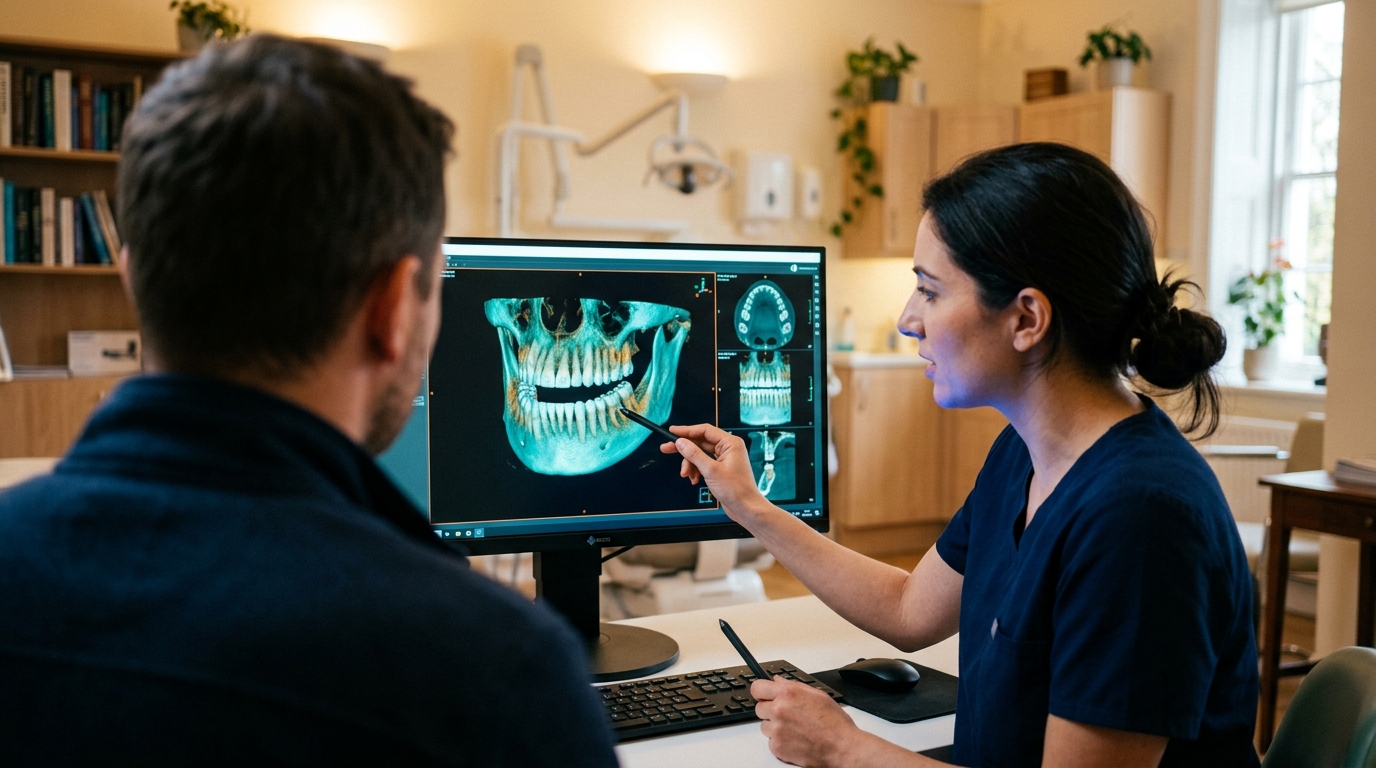
This is why a cone beam CT, a three dimensional scan of your jaw, is standard before implant planning. A flat x-ray shows height and nothing about width, so a site that looks fine on a regular film can turn out to be a knife edge ridge in cross section.
Bone disappears for predictable reasons. The biggest is time: once a tooth root is gone, the bone that supported it shrinks because nothing is loading it anymore. Gum disease removes bone directly. So does a difficult extraction, an old infection, or years of wearing a denture over the site.
If the scan shows you're short, grafting is the answer more often than not. Rebuilding a ridge, lifting a sinus floor to create height above the upper molars, or placing a small graft at the same moment a tooth comes out are all routine. They add months to the timeline and cost to the total, both of which are covered in our articles on implant cost and the implant procedure.
The practical takeaway: if you're having a tooth out and might want an implant later, ask about a graft at the extraction appointment. Preserving bone is far cheaper and simpler than rebuilding it.
Gum Health Matters More Than the Missing Tooth
An implant placed into an inflamed mouth is an implant placed into the same bacteria that caused the problem in the first place.
If you have periodontitis, gum disease that has progressed past the gums into the bone holding your teeth, it needs treating and stabilizing before any implant is planned. That usually means deep cleaning below the gumline, a period of healing, and a review to confirm the pockets have shrunk and the bleeding has stopped.
Two reasons this isn't optional. First, active infection near a surgical site raises the chance the implant never integrates. Second, the same immune response that let you lose teeth to gum disease makes you more susceptible to peri-implantitis, the equivalent condition around an implant, where bone is lost from around the fixture.
None of that rules you out. People with a history of treated gum disease get implants routinely. They just need closer monitoring afterward and shorter gaps between hygiene visits, and it's worth knowing that before you start rather than being surprised by the recall schedule.
Smoking Is the Biggest Thing You Control
If there's one factor on this page worth acting on, it's this one. Smoking narrows blood vessels and reduces the blood supply that healing tissue depends on, precisely when your jaw is trying to grow bone onto a piece of titanium. It raises the risk of early failure, raises the risk of losing bone around the implant years later, and slows healing after grafting.
Some surgeons decline to place implants for heavy smokers. Many will proceed but will tell you plainly that your risk is higher and may adjust the plan. Almost all will ask you to stop before surgery and stay stopped through the healing period.
That window is a genuinely effective compromise if quitting for good isn't realistic. Stopping for a couple of weeks before and several weeks after surgery covers the period when blood supply matters most. Ask your dentist for a specific target rather than guessing.
Vaping is not a proven safe substitute here. Nicotine itself constricts blood vessels, so a nicotine-containing vape is not a neutral swap.
Diabetes, Medications, and Medical History
Diabetes on its own does not disqualify you. Controlled diabetes with stable long term blood sugar readings is compatible with successful implants, and plenty of people with diabetes have them. Uncontrolled diabetes is a different matter: high blood sugar impairs wound healing and raises infection risk, and most surgeons will want your readings improved before booking surgery.
Other medical factors that come up:
- Blood thinners. Usually manageable. Modern practice generally avoids stopping anticoagulants for routine dental surgery, using local measures to control bleeding instead. Never stop a prescribed blood thinner on your own.
- Immune suppression. Whether from medication after a transplant, from a condition, or from chemotherapy, it changes healing and infection risk and needs coordinating with the physician managing it.
- Radiation to the head or neck. Radiation reduces the blood supply in bone permanently and raises the risk of poor healing after surgery in the treated area. This one needs specialist assessment rather than a general dental opinion.
- Pregnancy. Not a permanent barrier, just a reason to postpone elective surgery.
- Heavy grinding. Doesn't rule you out, but it changes the design: more implants, more robust materials, and a night guard as a condition of treatment rather than a suggestion.
Answer the medical questionnaire fully, including supplements and anything you take occasionally. The questions that feel irrelevant to your teeth are usually the ones that change the surgical plan.
Bisphosphonates and Other Bone Medications
This deserves its own section because it worries people more than almost anything else, often out of proportion.
Bisphosphonates are drugs that slow the breakdown of bone, prescribed for osteoporosis and for some cancers. Related medications work differently but raise the same question. They are associated with a condition called osteonecrosis of the jaw, where an area of jawbone fails to heal after surgery or an extraction and the bone is exposed.
The risk is not uniform, and the distinction matters:
- Low dose oral tablets taken for osteoporosis carry a low risk. Implants are frequently placed in people taking them, with discussion beforehand.
- High dose intravenous therapy, typically given as part of cancer treatment, carries substantially more risk, and elective jaw surgery is usually avoided.
- Duration matters. Longer time on the medication generally raises risk.
What to do: tell your dentist the exact drug name, the dose, how it's given, and how long you've been on it. Expect them to want to speak with your prescribing physician. Do not stop the medication yourself to make implants possible. Bisphosphonates persist in bone for a long time, so a short pause achieves less than people assume, and stopping osteoporosis treatment carries its own real risk.
Age: Too Young, and Never Too Old
At the young end there is a real limit. Implants do not move as the jaw grows, so an implant placed in a still growing teenager ends up sitting in the wrong place relative to the teeth around it, often looking sunken and short by the time growth finishes. Dentists wait until growth is complete, which happens later in boys than in girls and is confirmed with imaging rather than a birthday. A temporary replacement bridges the gap in the meantime.
At the older end there is no upper limit. What matters is bone quality, gum health, healing capacity, and the ability to tolerate the procedure, not the number. People in their seventies and eighties get implants routinely, and the argument for doing so is often stronger, not weaker: someone who has struggled with a loose lower denture for a decade has more to gain than most.
If You've Been Told You're Not a Candidate
Before accepting it as final, work out which "no" you got.
- "Not enough bone." Ask whether grafting could change that, and what kind. Ask whether shorter or narrower implants would fit. Ask whether a different position in the arch would work. Bone volume is the most commonly reversible refusal there is.
- "Your gums aren't healthy enough." This is a sequence, not a rejection. Ask what treatment is needed and what target has to be met before implants get reconsidered.
- "Your diabetes isn't controlled." Ask what reading they'd want to see, then work toward it with your physician.
- "We don't do that here." Some general practices refer complex cases out. That's not a verdict on your mouth. Ask for a referral to an oral surgeon or periodontist.
- A medication or medical reason. This is the category where the answer may genuinely be no, and where an implant-retained or conventional denture becomes the sensible route instead.
A second opinion is reasonable, particularly from a specialist who handles complex bone cases, and particularly if the refusal came without a three dimensional scan. Asking for one is normal and nobody will take offense.
Frequently Asked Questions
Can I get implants if I have gum disease?
Not while it's active. Once it's treated and stable, yes, with more frequent maintenance visits afterward because you're at higher risk of the same process happening around the implant.
Am I too old for dental implants?
Age alone doesn't disqualify anyone. Your dentist is assessing bone, gum health, medical conditions, and how well you heal, and healthy people in their eighties have implants placed successfully.
Do I need a bone graft?
Only a three dimensional scan can answer that. Grafting is very common, especially where a tooth has been missing for years, and it adds months to the timeline rather than making implants impossible.
Will smoking stop me from getting implants?
It might, depending on the surgeon and how much you smoke. More often it means being told your failure risk is higher and being asked to stop before surgery and through healing, which is a genuinely worthwhile trade.
I take alendronate for osteoporosis. Can I still have an implant?
Usually yes. Low dose oral bisphosphonates carry a low risk of jaw healing problems, and implants are placed in people taking them regularly. Bring the exact drug name and how long you've been taking it, and expect your dentist to consult your physician.
What to Do Next
Book a consultation that includes a cone beam CT scan, and take a written list of every medication and dose with you. Those two things answer most of this page for your specific mouth in a single appointment.
If you've already been told no, ask the question that actually resolves it: is this a permanent no or a not yet, and if it's a not yet, what exactly has to change first? Write down the answer. Most people find they're looking at a plan with steps in it rather than a closed door.
This article is for general information only and is not a substitute for professional dental advice. Always consult your dentist about your individual needs.