Cracked or Chipped Tooth: What to Do Next
From a harmless enamel chip to a split root, here is how to tell what you are dealing with, what each one needs, how to hold it together until you are seen, and the signs that mean today.
Something gave way while you were eating, or your tongue has found a rough edge that was not there this morning. Maybe there is a piece of tooth in your hand.
"Cracked tooth" covers an enormous range. At one end is a chip off the enamel that needs nothing more than a polish. At the other is a fracture running down inside the root, where the tooth cannot be saved at all. The two feel surprisingly similar in the first hour, which is why guessing is a poor strategy.
Here is how to work out roughly where on that range you are, what to do tonight, and which signs mean you should not wait until next week.
Get Seen Today If Any of These Are True
Most broken teeth are not emergencies. These are:
- You can see a pink or red dot in the middle of the break. That is the pulp, the nerve and blood supply inside the tooth, and it is now open to the mouth. It will be intensely sensitive and it needs covering quickly.
- The tooth is bleeding from the broken surface itself, not just from the gum around it.
- Severe or throbbing pain, especially pain that arrives on its own rather than only when you bite.
- The tooth is loose, or it has moved, or it no longer meets the opposite tooth the way it used to.
- Your face or gum is swelling, or you have a fever, a bad taste, or a spreading ache. That combination points to infection, and our guide on tooth abscess warning signs explains which of those signs mean the hospital rather than the dental chair.
- The break happened in an accident with a blow to the face. Get the jaw and the neighboring teeth checked even if only one tooth looks damaged.
If none of those apply, you probably have days rather than hours. Book anyway, because cracks do not stay the same size.
The Range: From an Enamel Chip to a Split Root
| Type of damage | What it usually feels like | What it typically needs | Typical cost range |
|---|---|---|---|
| Craze lines, hairline cracks in the enamel only | Nothing at all, visible in certain light | No treatment. Cosmetic only if they stain | Roughly $0 to $200 to polish |
| Small enamel chip | A rough edge your tongue keeps finding, no pain | Smoothing, or bonding if it shows when you smile | Roughly $50 to $600 |
| Chip through to the dentin, the softer layer under the enamel | Sharp twinges with cold, sweet, or air | Bonding, or an onlay on a back tooth | Roughly $150 to $1,500 |
| Fractured cusp, where a corner of a back tooth snaps off, usually beside a large old filling | A sudden sharp break while eating, then surprisingly little pain | A crown or onlay to rebuild the chewing surface | Roughly $650 to $2,500 |
| Cracked tooth, a crack running from the chewing surface toward the root | Pain when you release a bite more than when you bite. Comes and goes | A crown to hold it together, plus a root canal if the pulp is involved | Roughly $800 to $3,500 |
| Split tooth, where the crack has separated the tooth into segments | Constant pain on chewing, often a gum swelling | Removal of one segment if possible, otherwise extraction | Roughly $150 to $2,000 |
| Vertical root fracture, a crack starting in the root, often in a tooth that has had a root canal | Dull ache, a gum boil, sometimes no symptoms until an x-ray | Almost always extraction, then replacement | Roughly $150 to $650 to extract |
Treat those as ranges, not quotes. Where you live, the material chosen, whether the tooth needs a root canal first, and how much healthy tooth is left all move them significantly, and replacing an extracted tooth is a separate cost on top.
Why Pain on Release Is the Telling Sign
The classic symptom of a genuine crack, sometimes called cracked tooth syndrome, is not pain when you bite down. It is a sharp jolt in the moment you let go.
The reason is mechanical. Biting presses the two halves of the crack together. Releasing lets them spring apart, and the fluid movement inside the tooth's tiny tubules stimulates the nerve. That is why the pain is so fleeting, so hard to reproduce on demand, and so often dismissed for months.
Two other patterns fit a crack. Pain that only shows up on certain foods, particularly hard or fibrous ones, and only when the food lands at one specific angle. And sensitivity to cold on one tooth that has no visible decay.
Cracks in back teeth are frequently invisible on an x-ray, because an x-ray shows the tooth from the side and the crack often runs the same direction as the beam. So do not be surprised if your dentist cannot point to it on the screen. They will instead use a bite stick to load one cusp at a time, shine a light through the tooth, use a dye, or sometimes remove an old filling to look underneath. Finding a crack can genuinely take more than one visit.
What to Do Until You Are Seen
Keep the broken piece, in milk. If a clean fragment of a front tooth broke away, it can sometimes be bonded straight back on, which usually looks better than any rebuild. Store it in milk or saline so it does not dry out and take it with you.
Rinse with warm salt water. Half a teaspoon in a cup of warm water, once or twice, to clean the area gently.
Cover a sharp edge. Orthodontic wax, a small piece of sugar free chewing gum, or a pharmacy temporary filling kit will stop a jagged edge from shredding your tongue or the inside of your cheek. Temporary filling material is also the right thing for a hollow left where a chunk came out.
Stop chewing on that side entirely. Every bite on a cracked tooth widens the crack. This is the single most useful thing you can do, and the hardest to remember.
Avoid the triggers. Nothing very hot, very cold, or sugary until you are seen. Cold air over an exposed surface counts too.
Take ordinary painkillers as directed on the packet. Do not hold aspirin against the gum, which burns the tissue. Our guide on stopping a toothache tonight goes further into what helps overnight.
Do not glue it. Not superglue, not household adhesive, not denture adhesive on a tooth. These are not made for use in the mouth, they can damage the pulp, and they usually mean the fragment can no longer be bonded properly. People do this more often than you would think.
Why Teeth Crack
Almost every cracked tooth has a story behind it, and knowing yours matters, because a tooth that cracked for a reason that has not gone away will be followed by another one.
- Grinding and clenching. The most common underlying cause, and often unrecognized because it happens in your sleep. Look for morning jaw ache, flattened tooth edges, or a partner who mentions the noise.
- Large old fillings. A filling does not strengthen a tooth. A big one leaves thin walls of enamel with a wedge in the middle, and those walls eventually give way. This is why so many fractured cusps happen next to a decades old silver filling.
- Root canal treated teeth. A tooth with the nerve removed loses its blood supply and its structure has usually been thinned by decay and access. That is exactly why crowns are so often recommended after a back tooth root canal.
- Hard things you did not mean to bite. Popcorn kernels, olive pits, ice, hard candy, the corner of a fork, a stray piece of bone.
- Sudden temperature swings. Ice water immediately after hot coffee makes enamel expand and contract quickly.
- Trauma. A fall, an elbow, a steering wheel.
If grinding is the cause, a night guard is not a luxury. It is the thing that protects the crown you are about to pay for.
What Treatment Actually Involves
For a small chip, the appointment is usually short. Smoothing takes minutes. Bonding, where tooth colored composite resin is shaped onto the tooth and hardened with a light, typically takes half an hour to an hour and often needs no numbing at all.
For a fractured cusp or a crack, the aim is to wrap the tooth so the pieces can no longer flex apart. That is a crown, or an onlay if enough healthy tooth remains to keep. Expect either a two visit sequence with a temporary crown in between, or a single visit if the practice mills crowns on site.
If the pulp is inflamed or infected, a root canal comes first and the crown goes on afterward. Your dentist may not know at the outset whether the nerve will settle, and it is entirely normal to be told "let us crown it and see." That is not indecision. Whether a crack has reached the pulp is genuinely not always visible until the tooth has had a few weeks to declare itself.
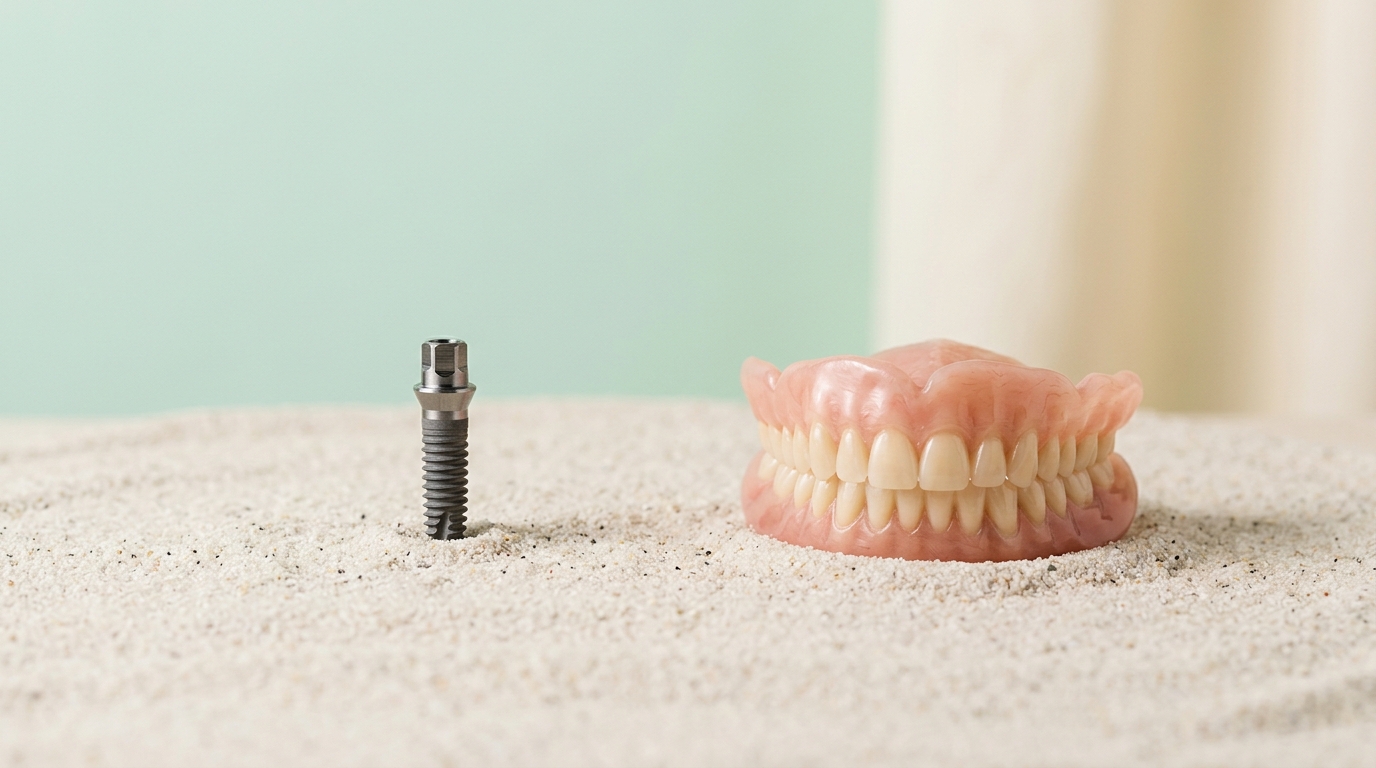
If the crack runs below the bone level or has split the root, no crown will hold it, and extraction is the honest answer rather than a failure. From there the options are an implant, a bridge, or a partial denture, covered in our separate implant guides.
Frequently Asked Questions
Can a cracked tooth heal itself?
No. Enamel has no living cells and no blood supply, so it cannot regrow or knit back together the way bone does. A crack that stops hurting has not healed. It has either settled temporarily or the nerve inside has died, and the second of those is worse news than the pain was.
My tooth chipped but it does not hurt at all. Do I still need to go?
Yes, though not urgently. A painless chip may be enamel only, which is easy to deal with, but it can also be a fracture that has not yet reached the nerve. A quick look tells you which, and a small repair now is far cheaper than a crown later. A sharp edge is also worth smoothing before it cuts your tongue repeatedly.
My dentist cannot find the crack. Am I imagining it?
Almost certainly not. Cracks are notoriously difficult to see, they often do not show on x-rays, and the symptoms come and go. Keep a note of exactly which foods set it off and whether the pain comes on biting or on release, and take that to your appointment. That detail frequently identifies the tooth when the examination alone cannot.
Can I superglue my tooth back on?
No. Household adhesives are not safe in the mouth, they can irritate or damage the pulp, and the residue usually ruins the surface a dentist would have bonded to. Put the fragment in milk and take it in instead.
Will a crown definitely save a cracked tooth?
Usually, but not always, and any dentist who promises otherwise is overselling it. A crown holds the tooth together and prevents the crack from spreading, which works well when the crack is confined to the crown portion of the tooth. If it has already extended into the root, the crown buys time rather than fixing it.
Is a chipped front tooth fixable in one visit?
Often yes. Composite bonding is done in a single appointment and can look very close to the original tooth. If the chip is large or the tooth is discolored as well, a veneer or a crown may be suggested instead, which takes longer but lasts longer. Our veneer guides cover that comparison in detail.
What to Do Next
Check the urgent list at the top first. A visible pink dot, a loose tooth, bleeding from the tooth itself, swelling, or severe pain means today.
If none of that applies, keep any fragment in milk, cover the sharp edge, stop chewing on that side, and get an appointment in the next few days. When you call, say whether the pain comes on biting or on letting go, and which foods trigger it. That one sentence often saves an entire diagnostic visit.
And if the tooth broke while you were biting something entirely ordinary, ask about grinding at the appointment. A tooth that cracks under normal chewing force is usually telling you about a force problem, not a food problem.
This article is for general information only and is not a substitute for professional dental advice. Always consult your dentist about your individual needs.