Dental Implants vs Dentures: An Honest Comparison
A real head to head on bone loss, bite force, daily upkeep, and what each option costs over fifteen years, plus who genuinely does better with a denture.
You're losing teeth, or you've already lost them, and you've been handed two options with prices that aren't in the same universe. One is a few thousand dollars and you could have it in weeks. The other is tens of thousands and takes most of a year.
The temptation is to treat that as a straight question of what you can afford. It isn't, because the two options do genuinely different things to your jaw over time, and the cheaper one has running costs that the quote never mentions.
This is the comparison laid out properly: what each does to bone, what you can actually chew, what each asks of you every day, and what the total looks like over fifteen years rather than on the day you sign.
The Difference That Drives Everything Else
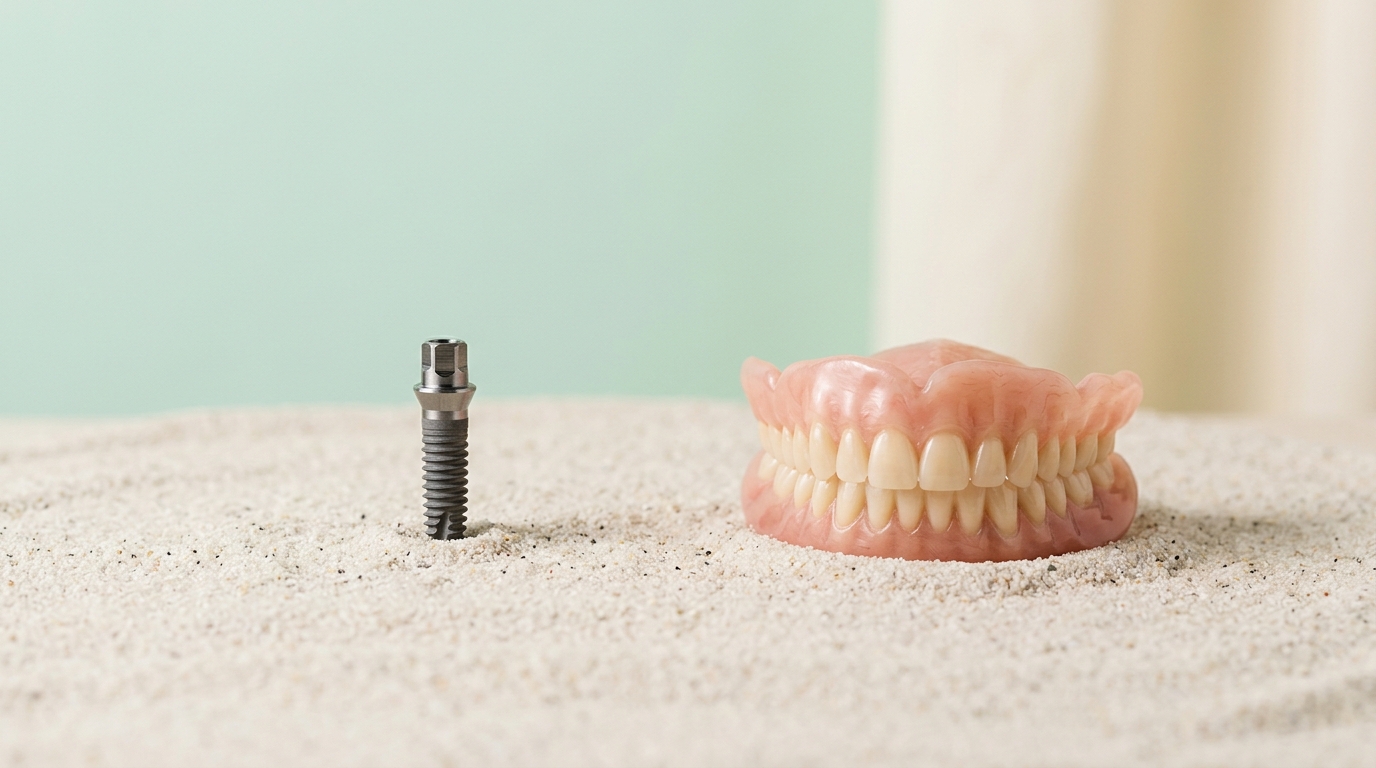
A denture rests on your gums. It's supported by the ridge of bone underneath, by suction, by the muscles of your cheeks and tongue, and sometimes by clasps hooked around remaining teeth. Nothing anchors it.
An implant goes into bone. The titanium post fuses with your jaw and takes chewing force the way a root did. The teeth attached to it don't move, because they're bolted to your skeleton.
Almost every practical difference below flows from that one structural fact. It's worth holding onto, because it explains why the comparison isn't simply "removable and cheap" versus "fixed and expensive."
What Happens to Your Jaw Underneath a Denture
This is the part that rarely comes up in the first conversation, and it's the strongest argument for implants.
Your jawbone maintains itself in response to load. When a tooth root is pressing into bone every time you chew, the bone has a reason to stay. Remove the root and that signal stops. The ridge starts to shrink, a process called resorption, where the body gradually reabsorbs bone it no longer has a use for.
A denture does not stop this. It presses on the gum tissue above the bone rather than into the bone, and that surface pressure doesn't provide the same stimulus. So the ridge that your denture was fitted to keeps changing shape underneath it, faster in the first year after extractions and then more slowly for the rest of your life.
Three consequences follow, and they compound:
- The fit gets worse. A denture made for the ridge you had two years ago no longer matches the ridge you have now, which is why relines exist.
- There is less to hold onto. A tall ridge grips a lower denture reasonably well. A flat one gives it almost nothing, and lower dentures on a resorbed ridge are notoriously unstable.
- Your face changes. Losing vertical height in the jaws shortens the lower third of the face, which is where the collapsed, aged look associated with long term denture wearing comes from.
An implant interrupts this. Because it transmits chewing force into bone, it preserves bone in the immediate area. It won't rebuild what's already gone, and it only protects the region around itself, but it stops the local decline.
If you're going to be without teeth for a long time before deciding, this is the argument for deciding sooner. The more bone you have when you choose, the more options you still have.
Chewing Force and What You Can Actually Eat
A full denture delivers a fraction of the bite force of natural teeth. The reason is simple: bite down hard on a denture and it lifts, tips, or digs into gum tissue that has no business taking that load. Your nervous system learns this quickly and limits how hard you're willing to push.
In practice that means steak, crusty bread, apples bitten into rather than sliced, corn on the cob, nuts, and anything requiring a firm tear become difficult or off limits. Plenty of people adapt and eat well within those limits. Plenty of others quietly narrow their diet toward soft food and lose enjoyment along with variety.
Implants restore most of what you lost. Because force goes into bone, you can bite properly. Most people with implant-supported teeth eat without thinking about it, which is the thing they mention first when asked what changed.
One nuance: an implant has no periodontal ligament, the shock absorbing layer that suspends a natural tooth and senses pressure. So implants transmit force efficiently but give you less feedback about how hard you're biting. That matters for the crown and for grinders, and it's covered in more depth in our piece on how long implants last.
Head to Head
| Full denture | Implant-supported teeth | |
|---|---|---|
| How it stays in | Suction, ridge shape, muscle control, adhesive | Fused to bone |
| Effect on jawbone | Bone continues to shrink underneath | Preserves bone around each implant |
| Bite force | A fraction of natural teeth | Close to natural in most cases |
| Covers roof of mouth | Upper dentures usually do, which dulls taste | No palate coverage with a fixed bridge |
| Comes out at night | Yes | Fixed options never come out, snap-on options do |
| Daily care | Remove, brush, soak, clean the gums separately | Brush, plus interdental brushes or a water flosser |
| Speech at the start | Lisping and slurring for days to weeks | Little to no adjustment period |
| Time to finish | Weeks | Four months to over a year |
| Surgery required | None | Yes, plus grafting in some cases |
| Repairs and adjustments | Relines every few years, remakes, sore spot adjustments | Occasional screw tightening, crown replacement eventually |
| Typical upfront cost per arch | $1,500 to $4,000 for a conventional full denture | $6,000 to $15,000 for a snap-on denture, $15,000 to $35,000 fixed |
| Realistic fifteen year total | $4,000 to $10,000 with relines and one or two remakes | Upfront cost plus maintenance, usually no full replacement of the implants |
These are ranges, not quotes. Location, materials, how many implants an arch needs, and how much preparation your jaw requires all move them significantly, and only an itemized written plan from your own dentist reflects your actual situation.
The Cost Over Fifteen Years, Not the Cost Today
The sticker gap is real and large. But dentures are not a single purchase, and comparing one denture quote to one implant quote overstates the difference.
A denture needs a reline, where new material is added to the fitting surface to match a ridge that has changed shape, typically every few years. It needs occasional adjustment for sore spots. It gets dropped and cracked. And it needs full replacement periodically, because the teeth wear flat and the base no longer matches your mouth. Add adhesive and cleaning tablets as a small but permanent running cost.
Implants front load almost everything. The large payment happens once, and afterward you're paying for hygiene visits you'd be having anyway, plus a crown or prosthesis replacement somewhere down the line.
Over fifteen years the gap narrows. It rarely closes: implants generally still cost more in total. But the comparison shifts from "four times the price" to "more expensive, and here is what the extra buys," which is a much more useful conversation to have with yourself.
The Middle Ground Most People Don't Hear About
The choice is not binary, and the option in between is the one that suits the largest number of people.
An implant-retained denture, sometimes called an overdenture, is a removable denture that clips onto two to four implants. It comes out for cleaning like a conventional denture, but it doesn't move while you eat and it doesn't need adhesive. On a lower jaw, where conventional dentures are least stable, even two implants make a dramatic difference.
Above that sits the fixed full arch, a bridge screwed onto four to six implants that you never remove. It feels closest to having teeth again, costs the most, and is cleaned in your mouth rather than in a sink.
If the fixed option is out of reach, the snap-on version is not a consolation prize. It solves the single worst problem with dentures, which is a lower plate that lifts when you chew.
Who Each One Actually Suits
A conventional denture is genuinely the better call if:
- You need teeth soon and can't wait months for healing
- Cost is the binding constraint and financing isn't realistic
- You smoke heavily and aren't going to stop, which substantially raises implant failure risk
- You have a medical condition or medication that makes jaw surgery inadvisable, including some bone medications
- You've already lost so much bone that implants would need extensive grafting you'd rather avoid
- You're comfortable with the trade and simply don't want surgery, which is a legitimate reason on its own
Implants are worth stretching for if:
- You have a lower jaw and a flat ridge, where dentures perform worst
- You gag badly with a plate covering your palate
- Eating a full range of food matters to you
- You're relatively young, because you're looking at decades of ongoing bone loss otherwise
- You've already tried a denture and can't get on with it
- You're a public speaker, teacher, singer, or anyone whose work depends on your mouth behaving predictably
Whether you're a candidate for implants at all is a separate question with its own set of medical checks, and it's covered in its own article.
Frequently Asked Questions
Are implants worth it compared to dentures?
If you can afford them and you're a candidate, they solve problems dentures don't: bone loss, bite force, and the daily awareness that something in your mouth might move. If cost is genuinely prohibitive, a well made denture is a legitimate and widely used solution, and an implant-retained denture is a strong compromise.
Can I switch from dentures to implants later?
Often yes, but the longer you wear a denture the more the ridge shrinks, which can mean grafting before implants become possible. Switching later is common. It's just sometimes more expensive than choosing implants at the outset.
How many implants do I need to replace a full arch?
Usually two to four for a snap-on denture, and four to six for a fixed bridge you never remove. You do not need one implant per tooth, which is why full arch work costs far less per tooth than replacing single teeth individually.
Will people be able to tell?
A well made denture is hard to spot at rest. It's more likely to give itself away in movement: a slight click, a shift when you laugh, or the way you handle a hard bite. Fixed implant teeth don't move at all, so there's nothing to notice.
Do dentures change how food tastes?
Upper dentures usually do, because covering the palate blocks temperature sensation and some of the surface involved in flavor. Lower dentures and fixed implant bridges leave the palate uncovered, which is why people who switch often say food tastes right again.
What to Do Next
Ask for both plans in writing, priced fully, including the things that don't appear on the first page: relines and future remakes on the denture side, grafting and the final prosthesis on the implant side. Then ask one specific question that reveals more than any other: how much bone do I have right now, and how much will I have in five years if I do nothing?
If the answer is that your ridge is already thin, the decision is more time sensitive than it feels. If you have good bone and a healthy mouth, you have room to think it through properly.
This article is for general information only and is not a substitute for professional dental advice. Always consult your dentist about your individual needs.