Do I Need My Wisdom Teeth Removed? The Honest Answer
Not every wisdom tooth has to come out. Here are the reasons that genuinely justify surgery, the ones that sound convincing but are not, and what to ask.
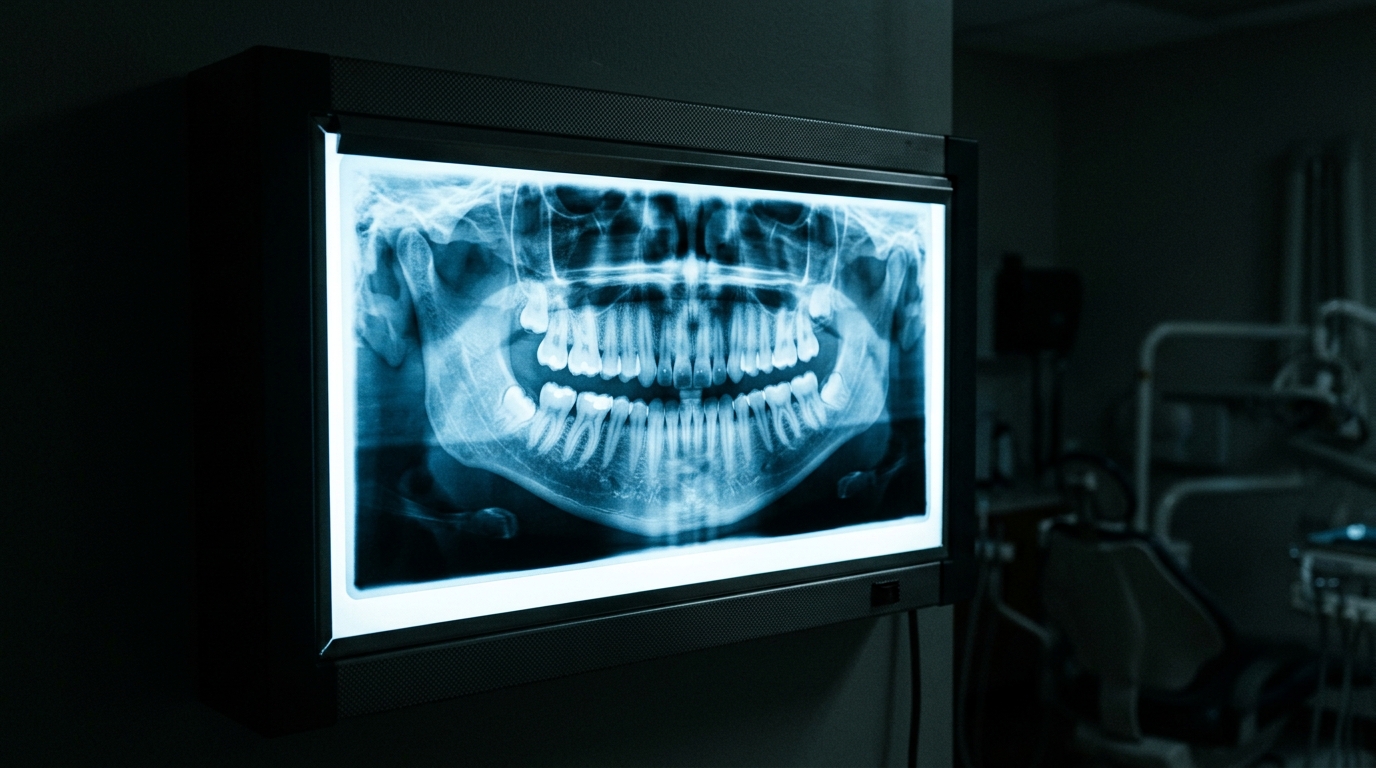
Someone has pointed at an X-ray and said your wisdom teeth should come out. Or nobody has said anything yet, but you can feel pressure at the back of your jaw and you would like to know whether you are heading for surgery.
Here is the part that often gets skipped: plenty of people go their whole lives without having theirs removed, and that is a perfectly good outcome. Wisdom teeth are not automatically a problem. Some are, some will be, and some simply sit there doing nothing for decades. The whole question is which of those three you have.
This covers the reasons that genuinely justify removal, the ones that sound persuasive but are weaker than they seem, what it means to monitor instead of operate, why your age changes the calculation, and the specific questions to ask so you leave the appointment understanding your own mouth.
What Wisdom Teeth Are and Why They Cause Trouble
Wisdom teeth are your third molars, the last four teeth at the very back of your mouth, one in each corner. They usually try to arrive in your late teens or early twenties, long after everything else has settled into place.
The trouble is space. By the time they show up, the jaw has finished growing and there is often no room left at the end of the arch. A tooth with nowhere to go becomes impacted, meaning it is blocked from coming through fully by bone, by gum, or by the tooth in front of it. Impacted teeth can sit at an angle, lie almost flat, or stay buried entirely.
Not all impaction is equal. A tooth completely buried in bone, with healthy tissue over it and no communication with your mouth, is sealed off from bacteria and frequently causes nothing at all. A tooth that is half through, with a flap of gum lying over part of the crown, is a different animal: it has an opening you cannot clean and bacteria can.
The Reasons That Genuinely Justify Taking Them Out
These are the situations where removal is not a preference, it is treatment.
Repeated pericoronitis. Pericoronitis is infection of the gum flap over a partly erupted wisdom tooth. It feels like a swollen, sore pad at the back of the jaw, often with a bad taste, difficulty opening wide, and sometimes swelling of the cheek or a sore throat on that side. One mild episode can settle with cleaning and irrigation. When it keeps returning, the flap is the problem, and the tooth under it usually needs to go.
Decay you cannot clean or restore. Wisdom teeth are hard to brush at the best of times, and a tilted one is nearly impossible. A cavity back there is often found late, sits below the gumline, and is difficult to fill well. If the tooth cannot be cleaned reliably and cannot be restored predictably, filling it is a temporary answer.
Damage to the second molar. This is the strongest argument on the list, because the tooth being protected is one you genuinely need. A wisdom tooth angled forward can press into the back of the second molar, the tooth immediately in front of it, causing decay on a surface no brush reaches, bone loss along that root, or in some cases resorption of the root itself. Once the second molar is damaged, you have traded one dispensable tooth for one that matters.
A cyst or other change around the crown. Unerupted teeth are formed inside a sac of tissue. Occasionally that sac enlarges into a dentigerous cyst, a fluid-filled cavity that slowly expands and hollows out bone around the tooth. It is usually painless, which is exactly why it gets found on a routine X-ray rather than through symptoms. Cysts need treating, and treating them normally means removing the tooth.
A gum pocket behind the second molar that will not settle. If the space behind your last standing molar traps plaque and stays inflamed and deep despite cleaning, the wisdom tooth is feeding a problem in your gums.
Infection, unexplained pain, or a tooth in the path of planned treatment. Abscess around a wisdom tooth needs prompt care. So does a tooth sitting in the way of jaw surgery, in the site of a planned implant, or under a denture that cannot be made to fit around it.
The Crowding Argument, and Why It Is Weaker Than It Sounds
You have probably heard that wisdom teeth push your front teeth crooked, and that removing them protects your smile or your orthodontic result. It sounds mechanically obvious. It is the least well supported reason on the list.
Lower front teeth crowd with age in most people, including people who never developed wisdom teeth at all and people who had them removed as teenagers. The drift appears to be driven mostly by ongoing changes in the jaw and by the natural tendency of teeth to move forward and settle over time, not by a shove from the back. Removing healthy wisdom teeth as a way of keeping front teeth straight has not held up.
What actually holds an orthodontic result in place is a retainer, worn as instructed, long term. If your orthodontist recommends removing wisdom teeth as part of a specific plan, that is a real clinical judgment about your specific bite. Removing them purely to prevent future crowding is not.
Reason by Reason, How Strong Is It
| Reason you have been given | What it actually means | How strong on its own |
|---|---|---|
| Repeated pericoronitis | The gum flap over the tooth keeps getting infected | Strong, especially after a second episode |
| Decay in the wisdom tooth that cannot be restored | A cavity in a tooth you cannot reach or fill well | Strong |
| Decay or bone loss on the back of the second molar | The tooth in front is being damaged | Strong, this is the tooth worth protecting |
| Cyst around an unerupted tooth | A fluid-filled sac expanding into bone | Strong, needs treatment regardless of symptoms |
| Persistent deep pocket behind the second molar | Gum inflammation that cleaning cannot resolve | Moderate to strong |
| Tooth in the path of jaw surgery, an implant, or a denture | It is physically in the way of planned treatment | Moderate, entirely case specific |
| Partly erupted and impossible to clean, no symptoms yet | Open to bacteria, high risk of future trouble | Moderate, a fair reason to plan ahead |
| Fully buried in bone, no symptoms, nothing on the X-ray | Sealed off, doing nothing | Weak, monitoring is reasonable |
| "They will crowd your front teeth" | A widespread belief about tooth movement | Weak on its own |
| "It is easier now than later" | True about recovery, but not a diagnosis | Weak alone, relevant alongside a real finding |
| "Everyone has them out eventually" | Not a clinical finding at all | Not a reason |
More than one line can apply to you, and different corners of your mouth can land on different lines. It is entirely normal to remove two and leave two.
Watchful Monitoring Is a Real Choice
If your wisdom teeth are not causing symptoms, are not damaging anything, and show nothing worrying on an X-ray, doing nothing on purpose is a legitimate plan. It has a name in dentistry, watchful monitoring, and it means you are choosing observation over surgery while agreeing to actually observe.
Monitoring is not the same as ignoring. It means:
- A check of the area at your regular appointments, including how well you can clean back there.
- An X-ray at sensible intervals, since cysts and damage to the second molar are usually silent.
- Knowing which symptoms end the wait: repeated swelling or infection, pain that is not from something else, a bad taste that keeps returning, food packing behind the last tooth, or difficulty opening your jaw.
The honest trade-off is this. Monitoring avoids surgery you may never need, and most people who monitor never end up in trouble. The cost is that if a problem does appear, it usually appears later in life, when recovery is slower and the roots are more developed. That is a real cost, and it is yours to weigh rather than something to be talked out of.
Why Your Age Changes the Math
Age does not determine whether a wisdom tooth needs to come out. It does change what removal is like.
In the late teens and early twenties, the roots are often not fully formed, the surrounding bone is more elastic, and healing tends to be quicker. In your thirties, forties, and beyond, roots are complete and sometimes curved, bone is denser, and the roots of lower wisdom teeth can sit closer to the inferior alveolar nerve, the nerve running through the lower jaw that supplies feeling to your lip and chin. Surgery is still routine at any age, but the procedure can be more involved, recovery slower, and the risk of a temporary or lasting change in lip sensation slightly higher.
That argues for making a decision rather than drifting. It does not argue for removing healthy teeth that are not going to cause a problem. The point of the age discussion is timing, not indication. If a tooth clearly needs to go, earlier is generally kinder to you. If it does not, being young is not a reason to operate.
Cost is worth naming too. A straightforward extraction of a fully erupted wisdom tooth typically runs somewhere around $150 to $400 per tooth, a surgical removal of an impacted tooth roughly $300 to $800 per tooth, and all four under sedation commonly lands somewhere in the range of $1,000 to $3,000 in total. These are ranges rather than quotes. Your location, the surgeon's training, the difficulty of the tooth, the type of anesthesia, and your insurance all move them, so ask for a written estimate before you agree.
How to Have the Conversation With Your Dentist
You are allowed to ask why. A good clinician will welcome it, because a patient who understands the reasoning turns up for the appointment and follows the aftercare.
Ask these:
- Which specific teeth are you recommending I remove, and why each one? Not "your wisdom teeth" as a set. Each tooth is its own decision.
- Can I see the X-ray, and can you show me the problem? Point at the second molar, the position of the roots, the pocket, the cyst. Seeing it changes the conversation.
- Is this causing a problem now, or preventing one later? Both are valid answers. You just deserve to know which one you are buying.
- What happens if I wait a year? What would make you call me back sooner?
- How difficult is my case, and would you refer me to an oral surgeon?
- What are the risks in my particular case, especially nerve proximity on the lower teeth?
- What is the full written cost, including anesthesia and follow-up?
If the answer to the first three questions is vague, or if you are told everyone needs them out, a second opinion is reasonable and normal. Take your X-ray with you or ask for a copy so you are not paying for imaging twice.
Frequently Asked Questions
Can wisdom teeth come in normally?
Yes. Some people have enough room and get four functional extra molars that erupt straight, bite properly against the opposing teeth, and can be cleaned. If yours fit and you can keep them clean, there is no reason to remove them.
What if I have no symptoms at all?
Then you are a candidate for monitoring rather than surgery, provided the X-ray is clean and your dentist can see no damage to the tooth in front. Keep the check-ups, though, because cysts and decay on the back of the second molar are usually painless until they are advanced.
Is it bad to have wisdom teeth removed in your forties or fifties?
No, it is done routinely. The roots are fully formed and the bone is denser, so surgery may take longer and recovery tends to be slower than it would have been at nineteen. If there is a genuine reason to remove the tooth, age is not a reason to leave it.
Do I have to have all four out at once?
Not necessarily. Doing all four in one session means one recovery and one anesthetic, which many people prefer. Doing one side at a time lets you chew on the other side throughout. If only one or two are actually causing problems, there is no obligation to remove the healthy ones.
Will removing them change my face or my jawline?
No. The teeth sit inside the arch of the jaw and their removal does not alter the shape of the bone or the line of your jaw. Swelling in the first few days can make your face look different temporarily, and that settles.
My dentist says they are fine but I keep getting sore gums back there. What is going on?
That pattern often means a partly erupted tooth with a gum flap trapping debris, which is pericoronitis in its milder form. Mention that it keeps recurring rather than describing only the current episode, because a repeating pattern is what shifts the decision.
What to Do Next
If you have pain, swelling, a bad taste, or difficulty opening your jaw right now, book an appointment rather than waiting it out. Repeated infection around a wisdom tooth does not resolve itself permanently.
If you have no symptoms and you have simply been told they should come out, go back with the seven questions above and ask to see the image. You may find there is a clear reason, in which case earlier is generally easier. You may equally find that the honest answer is that nothing is wrong yet, and that watching carefully is a perfectly respectable plan.
Either way, make the decision deliberately, tooth by tooth, and write down what you were told. That is the difference between choosing surgery and being swept into it.
This article is for general information only and is not a substitute for professional dental advice. Always consult your dentist about your individual needs.