Dental Bonding for Chipped Teeth: What to Expect
What happens in the chair when a chipped tooth is bonded, step by step, whether it hurts, how long the repair lasts, and when a chip needs a crown or root canal instead.
You bit down on something hard, or caught a front tooth on the rim of a glass, and now there is a corner missing. Your tongue keeps finding the edge. It may not hurt at all, but it is the first thing you notice in the mirror.
For most small and medium chips, the fix is dental bonding, which means rebuilding the missing part of the tooth with a tooth-colored resin that is shaped by hand and hardened in place. It is usually done in a single visit, often without an injection.
Here is what happens during the appointment, how long the repair tends to last, how to look after it, and when a chip needs something bigger than bonding.
First, Is Your Chip Urgent?
Most chips can wait a few days for a routine appointment. Call a dentist today and ask for an emergency slot if:
- You can see a pink or red spot in the middle of the break, or the tooth is bleeding from the broken surface. That usually means the pulp, the nerve and blood supply inside the tooth, is exposed.
- The pain is severe, throbbing, or keeps going after whatever triggered it has gone.
- The tooth feels loose, has shifted, or no longer meets the opposite tooth the way it did.
- The chip came from a blow to the face, or your gum or face is swelling.
If any of those apply, protecting the nerve comes before any cosmetic repair. Our guide on what to do with a cracked or chipped tooth covers how to hold things together until you are seen.
If you found the broken piece, keep it in a small container of water or milk and bring it along. A clean, sizeable fragment can sometimes be bonded straight back on, which looks very natural because it is your own enamel.
What Bonding Is Made Of
The material is composite resin, a putty-like mix of plastic resin and fine glass or ceramic particles, available in many shades and levels of translucency. It holds on by grip more than glue, locking into microscopic pores created in the enamel, which is why bonding works best when plenty of healthy enamel surrounds the chip.
The Appointment, Step by Step
A single chipped front tooth usually takes 30 to 60 minutes. Larger rebuilds or several teeth take longer.
- A quick check. Your dentist looks for cracks running away from the chip, tests how the tooth responds to cold or tapping, and checks your bite. If the chip is deep or the tooth took a hard knock, an x-ray shows the root and surrounding bone.
- Shade matching. This happens early because teeth look lighter as they dry out. Your dentist compares shade tabs in good light and may harden a tiny test dot of resin on the tooth, then flick it off. If you plan to whiten, say so now: resin does not respond to whitening, so the usual order is whiten first, wait a couple of weeks, then bond.
- Keeping it dry. Moisture weakens the bond, so expect cotton rolls, suction, and occasionally a thin rubber sheet called a dental dam that isolates the tooth.
- Preparing the surface. Sharp edges are smoothed and the enamel beside the chip is lightly roughened, often with a gentle slope, called a bevel, so the resin blends in rather than meeting the tooth in a visible line. Any decay comes out now. This is the only stage where some people feel a twinge.
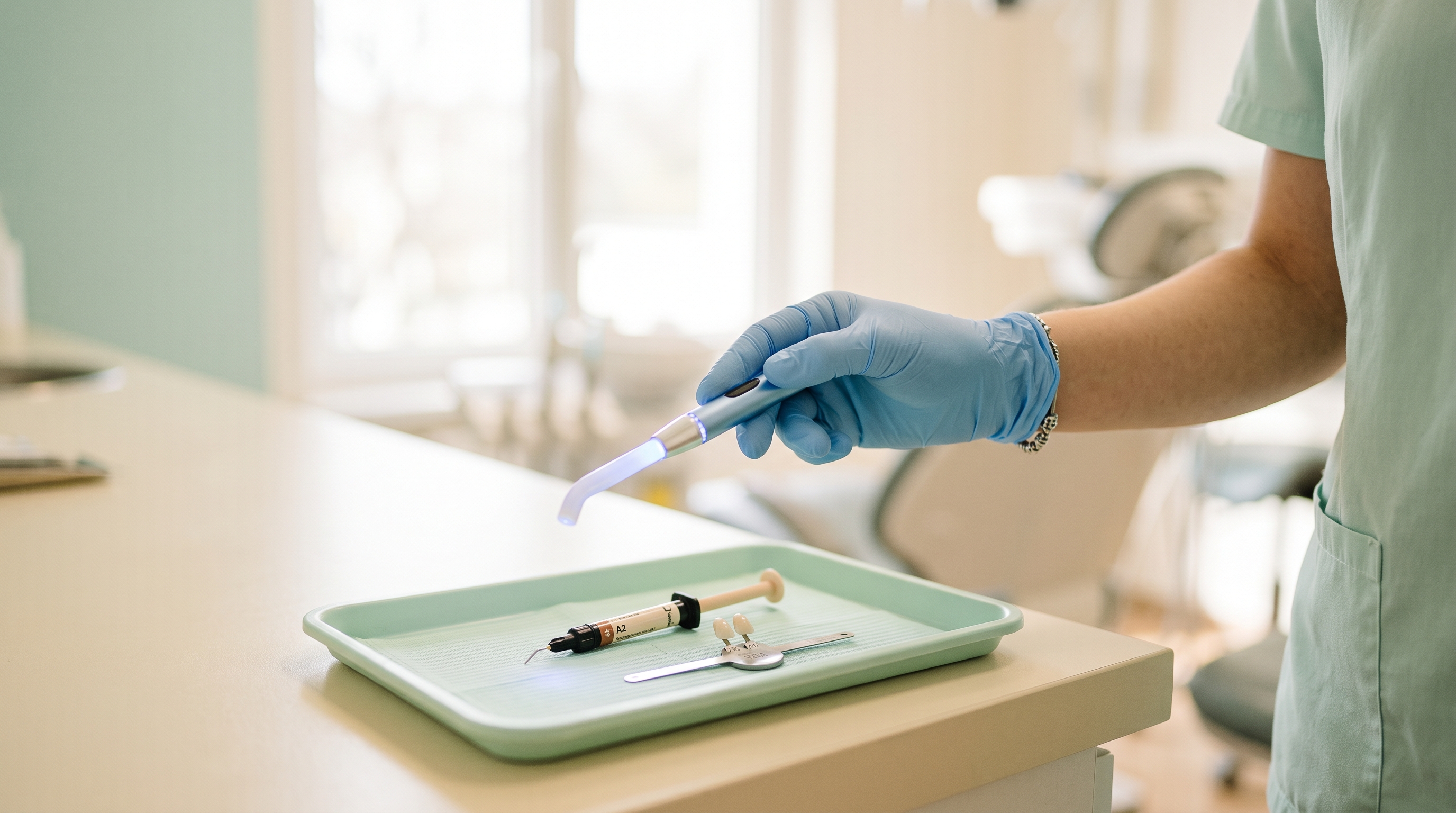
- Etching and adhesive. A mild acid gel goes on briefly and is rinsed off, leaving the enamel chalky and full of tiny pores. A thin adhesive is painted on and hardened with a blue curing light.
- Building up the resin. For a bigger chip, the dentist may use a silicone guide made from a model of the ideal shape. Resin goes on in layers, a more opaque one for the body of the tooth and a translucent one for enamel, each sculpted and cured before the next. Layering is what separates bonding that disappears from bonding that looks like a patch.
- Shaping and checking your bite. The resin is shaped with fine burs, discs, and thin strips between the teeth. You bite on colored paper that marks any high spots, because a repair that sits even slightly high takes the full force of your bite and chips more easily.
- Polishing. Progressively finer polishers bring the surface to the same gloss as the enamel beside it, which also helps it resist stain.
Will You Need a Numbing Injection?
Often not. Enamel has no nerves, so if the chip is confined to enamel, most people are comfortable without anesthetic. You are more likely to be offered numbing if the chip reaches the dentin, the softer and more sensitive layer under the enamel, if there is decay to remove, if the tooth is tender from the injury, or if the repair sits close to the gum. You can also simply ask for it.
Size of Chip and the Likely Fix
The size and position of the break decide what a tooth needs more than anything else. Treat this as a general guide, since only an exam can confirm which row you are in.
| Size and type of chip | What you usually notice | Likely fix | Typical cost range |
|---|---|---|---|
| Tiny nick or rough spot in the enamel | A sharp edge your tongue finds, no pain | Smoothing and polishing, sometimes a small dab of bonding | Roughly $50 to $300 |
| Small chip on a front tooth, enamel only | A visible corner missing, no sensitivity | Bonding in one visit | About $150 to $600 |
| Chip into the dentin | Twinges with cold, sweet foods, or air | Bonding, with a protective liner if the chip is deep | About $150 to $600 |
| Large chip, a big share of a front tooth gone | An obvious change in shape, possibly sensitivity | Extensive bonding, a porcelain veneer, or a crown | $150 to $600 bonded, $900 to $2,500 for a veneer, $1,000 to $2,500 for a crown |
| Broken corner of a back tooth, often beside an old filling | A sudden break while chewing, a sharp edge | A bonded filling if the break is small, otherwise an onlay or crown | $150 to $600 bonded, $1,000 to $2,500 for a crown, onlays often a little less |
| Break exposing the pulp | A pink or red spot, bleeding, strong pain | Protecting the nerve, often a root canal, then bonding or a crown | Root canal $700 to $1,300 on a front tooth, $1,000 to $2,000 on a molar, plus the final repair |
| Crack running down into the root | Pain on biting, sometimes gum swelling | Often not repairable, usually extraction and a replacement tooth | Varies widely with the replacement chosen |
These are ranges, not quotes. Where you live, the materials used, how much tooth is missing, and whether the nerve needs treatment first all move the final figure. A chip repair is often billed like a filling, which many plans cover in part after your deductible, while purely cosmetic bonding usually is not. If a crown or root canal is on the table, the dental cost calculator gives you a starting range to plan around.
When a Chip Needs a Crown or Root Canal Instead
Bonding can only be as strong as what it is attached to. It is a poor choice when:
- Too much tooth is missing. A large bonded rebuild has little enamel to grip and takes heavy forces on a small base. On front teeth a veneer or crown may hold up better, and on back teeth, which take far more chewing force, a crown or onlay usually does.
- There is a crack, not just a chip. Bonding can cover a crack, but it does not hold the two sides of the tooth together. A crack running toward the root usually needs a crown to brace the tooth.
- The nerve is involved. If the pulp is exposed, or the tooth has lingering pain, throbbing, or pain that wakes you, a root canal, which cleans out and seals the inside of the tooth, usually comes first. A small, fresh exposure after an injury, especially in a younger person, can sometimes be covered with a protective material that keeps the nerve alive, which is one more reason to be seen quickly.
- The tooth has already had a root canal. Back teeth that have had one tend to be more brittle and generally do better with a crown.
- You grind heavily. Bonding on a biting edge wears and chips faster in people who grind, which makes a night guard close to essential.
A tooth that took a real knock can also lose its nerve slowly over the following months, even after a perfect repair. If it turns gray, a pimple-like bump appears on the gum above it, or a new ache starts, get it checked.
How Long Does Bonding Last?
A realistic expectation is roughly 3 to 7 years before a bonded repair needs polishing, patching, or redoing, and plenty last longer. A small patch on the front of a tooth is fairly protected, while a rebuilt biting edge takes force with every bite and chips more readily. Nail biting, chewing ice, and grinding all shorten its life, and resin slowly picks up stain from coffee, tea, red wine, and tobacco. It cannot be whitened, though a repolish often freshens it.
The upside is that a new chip in old bonding can usually be fixed by adding fresh resin in a short visit. If you are weighing bonding against porcelain for the longer term, we compare the two in dental bonding vs veneers.
Looking After a Bonded Tooth
The resin is fully hardened before you leave, so you can eat and drink straight away.
- Go easy on coffee, tea, and red wine for the first day or two, as many dentists suggest, then rinse with water after staining drinks.
- Do not use the tooth as a tool. No biting thread or packaging, and cut apples or crusty bread into pieces rather than biting into them with the repaired edge.
- Brush and floss as normal, paying attention to the join between resin and tooth, where plaque collects. Very abrasive whitening pastes can dull the polish.
- Wear a night guard if you grind, and a mouthguard for contact sports.
- Keep your regular checkups, so small chips and wear get fixed before they become big ones.
Call the practice if your bite feels high once any numbness wears off, if the tooth stays sensitive for more than a few days, or if an edge feels sharp. These are quick adjustments.
Frequently Asked Questions
Does dental bonding hurt?
Usually not. Enamel has no nerves, so smoothing and roughening a small chip is generally painless, and many people have it done without an injection. If the chip reaches the sensitive layer underneath or decay needs removing, your dentist will offer numbing first.
Can a chipped front tooth be fixed in one appointment?
In most cases, yes. Bonding is shaped directly on the tooth and hardened with a light, so there is no lab work and no temporary. A single front tooth commonly takes 30 to 60 minutes.
Can I whiten my teeth after bonding?
Whitening lightens natural tooth, not resin, so the bonded area stays the same shade while the teeth around it get lighter. Whiten first, let the color settle for a couple of weeks, then have the bonding matched. If you whiten afterward, expect to have the bonding redone to match.
Can bonding fall off?
It can, though a well bonded repair on healthy enamel usually stays put. It is more likely with large repairs, repairs on biting edges, heavy grinding, or biting hard objects. If a piece comes away, keep it, avoid chewing on that side, and book a visit, since reattaching or rebuilding it is usually quick.
What to Do Next
If you have any of the urgent signs above, such as a pink spot in the break, strong or lingering pain, a loose tooth, swelling, or an injury to the face, call a dentist today rather than waiting for a routine appointment.
If the chip is small and painless, book a regular appointment within the next week or two. Meanwhile, cover a sharp edge with dental wax or sugar-free gum, chew on the other side, and bring the broken piece if you have it. At the visit, ask whether bonding suits this tooth, what it will cost, and whether anything about the break points toward a crown or root canal instead.
This article is for general information only and is not a substitute for professional dental advice. Always consult your dentist about your individual needs.